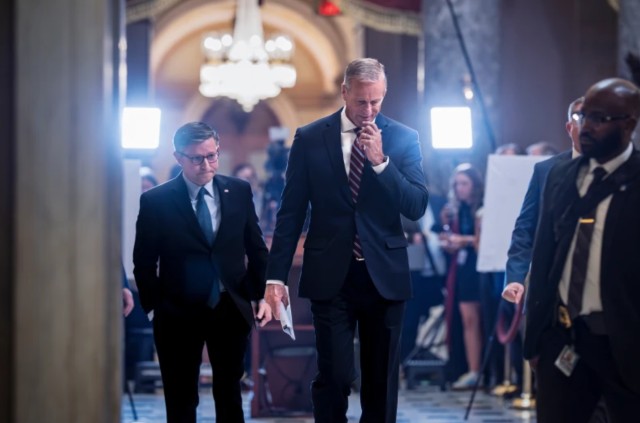
Speaker of the House Mike Johnson, R-La., left, and Senate Majority Leader John Thune, R-S.D., return to their offices after meeting with reporters on the third day of the government shutdown, at the Capitol in Washington, Friday, Oct. 3, 2025.
Hopes for a swift end to the government shutdown faded Friday as a crucial Senate vote failed once more. Democrats refused to support the Republican-backed funding bill, while President Donald Trump signaled plans for deep federal cuts and potential layoffs.
On the third day of the shutdown, the Senate rejected the measure to reopen the government in a 54-44 vote. The bill fell far short of the 60 votes needed to overcome a filibuster. Meanwhile, House Speaker Mike Johnson announced that the House would suspend legislative business next week, pressuring the Senate to act on the House-passed funding plan.
Senators quickly left the Capitol after the vote, with no further votes expected over the weekend. Both parties appeared entrenched, signaling a prolonged standoff that threatens federal workers and could ripple through the broader economy.
Senate Lines Harden Amid Standoff
Senate Majority Leader John Thune expressed frustration, questioning how many chances Democrats would get to “vote no.” Only three Democrats—Sens. Catherine Cortez Masto, John Fetterman, and Angus King—voted for the bill again, while Sen. Rand Paul remained the sole Republican opposing it.
Democratic leader Chuck Schumer said the party would not be intimidated. “They thought they could bludgeon us and threaten us and scare us. It ain’t working,” he said.
Democrats demand an extension of healthcare benefits. Republicans refuse to negotiate before reopening the government. Their strategy is to pressure Democrats into supporting a short-term funding bill at current spending levels.
Filibuster Rules Give Democrats Leverage
Although Republicans control the White House and Congress, Senate filibuster rules require 60 votes to pass funding legislation. With 47 Senate Democrats, the party can block measures and push for policy concessions.
The Democrats’ main demand focuses on health care. They want to extend COVID-era tax credits for plans offered under the Affordable Care Act (ACA), the signature law of former President Barack Obama.
“Everyone is about to experience dramatically increased premiums, co-pays, and deductibles because of the Republican health care crisis,” warned House Democratic leader Hakeem Jeffries.
Shutdown as a Political Gamble
Democrats are pursuing a high-risk strategy, essentially allowing the government to remain closed to strengthen their negotiating position. Trump has vowed to make the shutdown “painful” for them.
The president called the funding lapse an “unprecedented opportunity” to cut federal programs and potentially lay off workers rather than furlough them. A White House video even depicted budget director Russ Vought as a grim reaper.
Vought announced billions of dollars would be withheld from infrastructure projects in states with Democratic senators. On Friday, he added another $2.1 billion in Chicago infrastructure funding to the list.
Democrats remain resolute. “The cruelty that they might unleash on everyday Americans using the pretense of a shutdown is only going to backfire against them,” Jeffries said.
Economic Impact Mounts
The shutdown could affect roughly 750,000 federal employees, who could lose $400 million in daily wages. Reduced spending by furloughed workers could hurt the wider economy.
House Speaker Mike Johnson blamed Democrats for the situation. “All around the country right now, real pain is being endured by real people because the Democrats have decided to play politics,” he said.
White House press secretary Karoline Leavitt warned that military families were already seeking food aid as troops missed paychecks.
Talks Continue, But Solutions Unclear
Some bipartisan talks are underway, focusing on potential health care compromises. One proposal would extend ACA subsidies for one year before phasing them out.
Thune acknowledged the discussions, saying more productive talks happen outside leadership offices. He expressed openness to dialogue but insisted that reopening the government comes first.
While some Republicans support subsidy extensions, disagreements remain with the White House and GOP leadership. Schumer noted Democrats saw “nothing” offered by Republicans in late discussions.
The shutdown stalemate shows little sign of ending soon, leaving federal workers and the public in uncertainty.