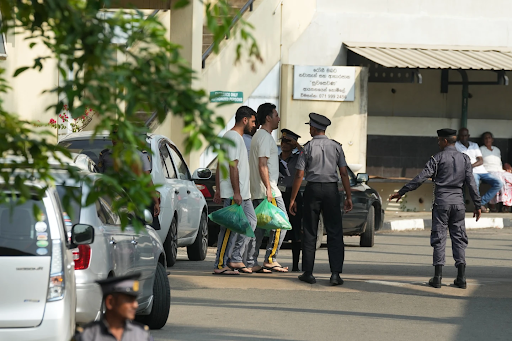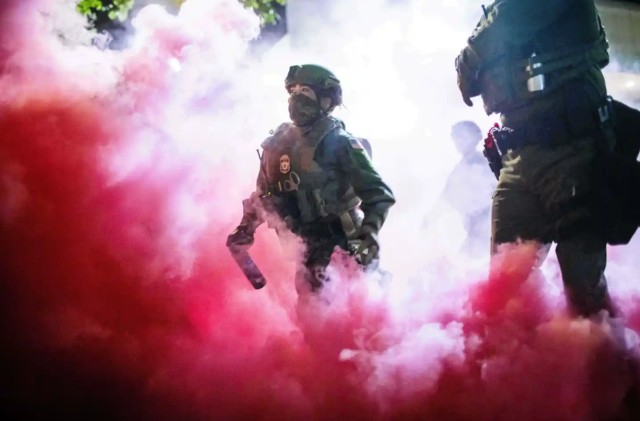
Police and federal officers throw gas canisters to disperse protesters near a U.S. Immigration and Customs Enforcement facility in Portland, Ore. on Sunday, Oct. 5, 2025.
A federal judge has once again blocked the Trump administration’s attempt to send National Guard troops to Oregon, escalating tensions between the White House and state leaders over ongoing protests in Portland.
Court Halts Deployment Plans
On Sunday evening, U.S. District Judge Karin Immergut issued a sweeping temporary restraining order. The ruling prevented the federal government from deploying National Guard troops from California and Texas into Oregon. Just a day earlier, the judge had blocked the use of Oregon’s own National Guard units.
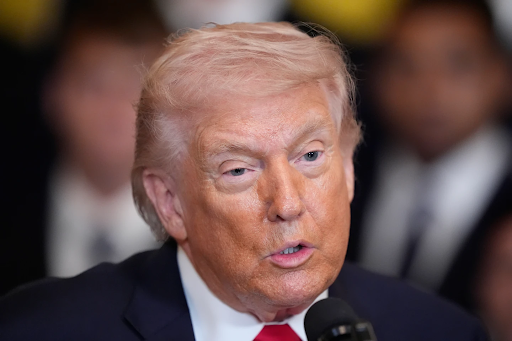
President Trump’s administration tried to bypass Saturday’s order by mobilizing troops from neighboring states. Immergut sharply questioned the move, calling it a direct violation of her earlier ruling. The White House offered no immediate response.
Protests Remain Small and Localized
Demonstrations outside Portland’s immigration processing facility have continued since January, with occasional flare-ups. However, Oregon officials emphasized the protests are confined to a single block and involve relatively small crowds. Governor Tina Kotek insisted there is no insurrection or national security threat requiring military force.
Despite this, about 200 California National Guard members were reassigned to Portland. Reports confirmed that 100 had already arrived, with another 100 en route when the court stepped in.
Legal Showdown in Court
The emergency hearing on Sunday turned tense. Immergut criticized federal lawyers for attempting to skirt her original order. She reminded them that the situation in Oregon had not changed and saw no legal grounds for federalized troops.
Oregon’s attorney, Scott Kennedy, revealed he learned of the Texas mobilization just minutes before the hearing. He described the government’s approach as “a game of rhetorical whack-a-mole.”
Texas Governor Greg Abbott defended the deployment, stating on social media that Texas would step in if Oregon objected. Illinois officials also confirmed troop mobilizations in their state, raising wider concerns.
Governors Push Back
California Governor Gavin Newsom condemned the use of his state’s troops, calling it “a breathtaking abuse of power.” He accused the president of weaponizing the military against American citizens.
Illinois Governor JB Pritzker voiced similar opposition, insisting Chicago did not require military presence. His office said he received no consultation from federal officials before the deployment.
Federal Power vs. State Sovereignty
The legal battle reflects a broader clash over state sovereignty. Oregon and California argued that sending troops from one state into another violated established norms. Judge Immergut supported that view, stressing that relatively small protests did not justify military intervention.
California Attorney General Rob Bonta called the president’s move “well outside of norms or practices.” He praised the ruling as a crucial step in resisting federal overreach, though he warned the battle was far from over.
Portland Leaders Decry Force
Portland Mayor Keith Wilson reported federal agents using pepper spray and impact munitions against demonstrators. He labeled the response as aggressive and unnecessary, adding that it only inflamed tensions. The city has alerted the Department of Justice’s civil rights division about the incidents.
The Bigger Picture
Since the start of his second term, President Trump has authorized or considered sending troops to at least 10 U.S. cities. His administration argues the deployments are necessary to protect federal property. State leaders, however, see the moves as an erosion of their authority.
For now, Judge Immergut’s order keeps Oregon free of outside National Guard deployments. But with federal officials exploring new avenues, the clash between states and Washington appears far from resolved.