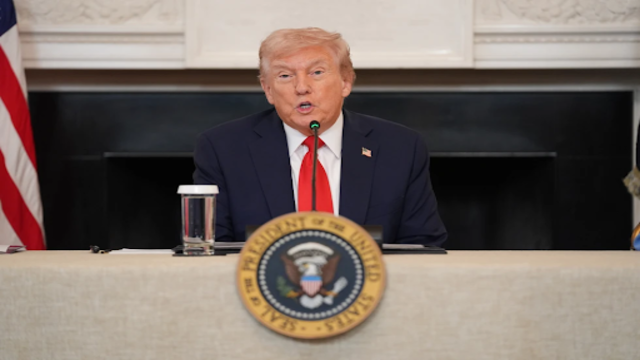
President Donald Trump speaks during a roundtable meeting on antifa in the State Dining Room at the White House, Wednesday, Oct. 8, 2025, in Washington. Associated Press
The Trump administration is under mounting pressure to provide evidence that boats targeted in recent U.S. military strikes were carrying drugs. According to two U.S. officials, Congress has yet to receive any concrete proof backing the administration’s claims.
Congress Frustrated Over Missing Proof
Lawmakers across party lines have expressed frustration. Despite repeated requests, the administration has only shared unclassified video clips on social media showing the attacks. These clips, posted by President Donald Trump and Defense Secretary Pete Hegseth, show explosions at sea but offer no visible evidence of narcotics.
So far, the U.S. military has launched at least four strikes, reportedly killing 21 people. Three of the targeted boats allegedly originated from Venezuela. Officials say the administration has not explained why it opted to destroy some vessels instead of intercepting them, as is the usual practice in drug interdiction missions.
Senate Rejects Resolution on War Powers
Amid growing bipartisan concern, the Senate voted down a war powers resolution that sought to limit Trump’s ability to authorize further strikes without congressional approval. Lawmakers are increasingly worried that the administration is stretching its war powers without adequate justification.
In a memo issued after one of the attacks, the Trump administration labeled drug cartels as “unlawful combatants.” It further declared that the U.S. is engaged in an “armed conflict” with these groups — a move that could redefine the legal boundaries of presidential military authority.
Pentagon Cites “Intelligence” But No Evidence
When pressed about the lack of hard proof, the Pentagon pointed to public statements by Hegseth and to social media videos of the strikes. Hegseth claimed that “intelligence, without a doubt,” confirmed the boats were trafficking narcotics and that those onboard were “narco-terrorists.”
However, the videos themselves offer no visible confirmation of drugs. Lawmakers remain skeptical, demanding classified documentation or clear intelligence supporting the administration’s claims.
Lawmakers Denied Access to Legal Opinion
Senator Angus King revealed that members of the Senate Armed Services Committee were denied access to the Pentagon’s legal justification for the strikes. During a confirmation hearing, CIA nominee Joshua Simmons declined to confirm whether he participated in any discussions regarding the legality of targeting cartels.
Attorney General Pam Bondi also refused to disclose whether her department provided Trump with legal advice to justify the strikes, citing confidentiality.
A White House official, speaking anonymously, argued that Congress has been adequately briefed. The official claimed that the Trump administration was “more transparent” about military actions than previous administrations. According to the Pentagon, six classified briefings have been held with lawmakers.
Self-Defense Argument at the Core
Trump officials maintain that the strikes are acts of self-defense against cartels responsible for the influx of deadly drugs into the U.S. They insist these operations are necessary to protect American lives.
Still, analysts point out that while Venezuela is a cocaine producer, most of its exports go to Europe, not the U.S.
Small Inner Circle Driving the Strikes
Sources say Trump has largely bypassed traditional interagency decision-making. A small inner circle — including Secretary of State Marco Rubio, Deputy Secretary Christopher Landau, and senior aide Stephen Miller — is said to be driving the strategy.
Rubio has long taken a hard stance against Venezuelan President Nicolás Maduro, who remains a target of U.S. indictments for narcoterrorism and cocaine trafficking. The U.S. has offered up to $50 million for information leading to his arrest.
Trump has claimed that members of the Venezuelan gang Tren de Aragua, allegedly tied to Maduro, were aboard the first targeted boat — though no evidence of such connections has been made public.
Diplomatic Tensions with Venezuela
Early in his term, Trump sent special envoy Richard Grenell to negotiate with Maduro. That visit secured the release of six detained Americans. However, diplomatic efforts have since stalled.
Maduro, sworn in for a third term earlier this year despite disputed election results, accuses Trump of trying to destabilize his government through these military actions.
The State Department has rejected those allegations. Spokesman Tommy Pigott reiterated that the U.S. operations are solely focused on countering narcotics trafficking, not regime change.
“Maduro is a fugitive of American justice,” Pigott said. “Our goal is to stop the poison reaching American shores — nothing more.”
As Congress awaits verifiable proof, questions linger about the legality, intent, and effectiveness of Trump’s escalating strikes on alleged drug boats in the Caribbean.