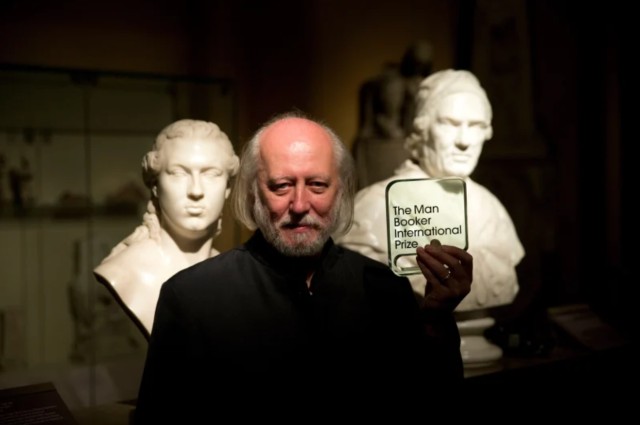
Hungary’s Laszlo Krasznahorkai poses for photographers in London, Tuesday, May 19, 2015.
Hungarian author László Krasznahorkai has won the 2025 Nobel Prize in Literature, earning global recognition for his darkly humorous and surreal storytelling. The Nobel judges praised him as a “great epic writer” whose work reveals the power of art amid apocalyptic terror.
The 71-year-old novelist, known for his long, uninterrupted sentences and bleak yet comic style, becomes Hungary’s first Nobel literature laureate since Imre Kertész in 2002. The award comes with a prize of 11 million Swedish kronor (around $1.2 million).
“I am calm and very nervous,” Krasznahorkai told Radio Sweden. “This is the first day in my life when I got a Nobel Prize. I don’t know what’s coming in the future.”
The Absurd World of Krasznahorkai
Critics have long hailed Krasznahorkai as one of Europe’s most profound and unconventional literary voices. American critic Susan Sontag once called him the “contemporary master of the Apocalypse.”
His works are often compared to Franz Kafka and Samuel Beckett, exploring the absurdity and hopelessness of human existence — all wrapped in sharp humor.
According to Zsuzsanna Varga, a Hungarian literature expert at the University of Glasgow, his novels “probe the utter hopelessness of life while being incredibly funny.” She likens his never-ending prose to the “Hotel California of literature — once readers enter, they can never leave.”
A Career of Unending Sentences and Endless Themes
Krasznahorkai debuted in 1985 with “Satantango,” a haunting story set on a dying collective farm. The novel laid the foundation for his signature style — long sentences, grim landscapes, and philosophical depth.
He went on to publish over 20 books, including “The Melancholy of Resistance,” a surreal tale involving a circus and a stuffed whale, and “Baron Wenckheim’s Homecoming,” a sprawling story of a gambling-addicted aristocrat.
His 2021 novel “Herscht 07769” — written as letters to then-German Chancellor Angela Merkel — is nearly 400 pages long with only one period.
Several of his works were adapted into films by Hungarian director Béla Tarr, notably “Satantango” and “The Melancholy of Resistance.”
Krasznahorkai has also drawn inspiration from his travels in Asia, penning works such as “A Mountain to the North, a Lake to the South, Paths to the West, a River to the East.”
The Road to the Nobel
Born in Gyula, near Hungary’s border with Romania, Krasznahorkai initially studied law before turning to literature. His early works earned a cult following among young Hungarians in the 1980s, when writers were “like pop stars,” according to Varga.
The Nobel committee member Steve Sem-Sandberg said the author had been on the radar for years, describing his career as “half a century of pure excellence.”
Editor János Szegő of Magvető publishing house noted that Krasznahorkai’s books often focus on life at the periphery and explore the techniques of power, from populism to mass manipulation.
A Voice Against Political Decay
Krasznahorkai has been openly critical of Hungarian Prime Minister Viktor Orbán and his nationalist policies. Earlier this year, he told Svenska Dagbladet that “there is no hope left in Hungary today,” blaming both politics and social decay.
Despite his criticism, Orbán congratulated the author on Facebook, calling him “the pride of Hungary” and celebrating him as the first Nobel laureate from Gyula.
Recognition Beyond Borders
Krasznahorkai’s literary excellence has been honored before. He received the Man Booker International Prize in 2015 and the National Book Award for Translated Literature in 2019 for “Baron Wenckheim’s Homecoming.”
He humbly described his writing journey as accidental: “I wanted to write only one book. Then I rewrote it, trying to correct it. My life is a permanent correction.”
Continuing the Legacy of Literature
The Nobel Prize in Literature has been awarded 117 times to 121 laureates. Recent winners include South Korean author Han Kang (2024) and Norwegian writer Jon Fosse (2023).
The 2025 Nobel announcements continue this week, with the Nobel Peace Prize to be revealed on Friday, followed by the Economic Sciences award on Monday.
The Nobel ceremonies will take place on December 10, marking the anniversary of Alfred Nobel’s death. Each laureate receives an 18-carat gold medal, a diploma, and the monetary prize.
With this honor, László Krasznahorkai cements his place among the world’s most influential writers — a master of absurdity whose words turn chaos into art.