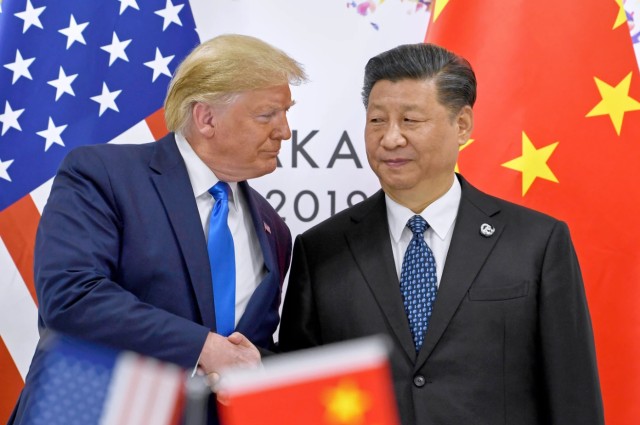
U.S. President Donald Trump, left, shakes hands with Chinese President Xi Jinping during a meeting on the sidelines of the G-20 summit in Osaka, western Japan, June 29, 2019.
President Donald Trump on Friday warned of imposing a 100% tariff on Chinese imports starting November 1, or possibly earlier. The move follows China’s new export restrictions on rare earth minerals, escalating tensions between the world’s two largest economies.
Trump expressed frustration over Beijing’s controls, saying they leave the U.S. “captive” to Chinese dominance in key minerals. He suggested that these restrictions might also affect his planned meeting with Chinese President Xi Jinping during a South Korea trip.
“I don’t know that we’re going to have it,” Trump told reporters in the Oval Office. “But I’m going to be there regardless, so I would assume we might meet.” He also indicated there could be time to adjust the proposed tariffs depending on China’s actions.
China Tightens Rare Earth Exports
China’s government on Thursday imposed new rules on rare earth minerals. Foreign firms now require special approvals to export these metals, which are critical for electronics, jet engines, computer chips, and lasers. China also restricted technologies used in mining, smelting, and recycling of rare earths. Any exports linked to military products will be denied.
Trump described the measures as “shocking” and “out of the blue,” calling China “very hostile” on social media. He added that the U.S. may respond with its own export controls on critical American software.
The Chinese Embassy in Washington has yet to comment.
Market Reacts to Escalating Tensions
Financial markets responded immediately. The S&P 500 fell 2.7%, marking its worst day since April when similar tariff threats were made. Analysts warned that the proposed 100% tariff, combined with the 30% already in place, could stall U.S.-China trade and slow global growth.
Despite the strong rhetoric, Trump has previously backed down from such threats. Investors have even coined a strategy called “TACO” — Trump Always Chickens Out — based on his history of retreating from aggressive trade moves.
Political and Economic Implications
Experts note that massive tariffs could aggravate domestic economic pressures. Inflation may rise, the job market could weaken, and the fallout from a potential government shutdown may compound the challenges.
Trade tensions have simmered since earlier U.S. tariffs prompted a prolonged trade war. Both countries had previously agreed to reduce tariffs following negotiations in Switzerland and the United Kingdom. Still, China’s rare earth export controls continue to complicate the U.S. supply of vital industrial materials.
The European Union Chamber of Commerce in China highlighted that Beijing’s latest restrictions “add further complexity to the global supply chain of rare earth elements.”
Flashpoints in U.S.-China Trade
The trade relationship remains volatile. U.S. restrictions on advanced Chinese computer chips, American soybean sales, and port fees on both sides are additional stress points. These issues could compound tensions if tariffs or export limits escalate.
Analysts See Room for De-escalation
Trump has not canceled his Xi meeting but has left uncertainty. The trip also includes stops in Malaysia, Japan, and South Korea. Experts suggest that while Beijing’s export controls are a strong reaction, there is potential for de-escalation.
Sun Yun of the Stimson Center called China’s response “disproportional” but noted room for mutual compromise to preserve high-level talks. Gracelin Baskaran of the Center for Strategic and International Studies emphasized China’s dominance in rare earths, which gives it negotiating leverage for high-tech and military applications.
Craig Singleton, of the Foundation for Defense of Democracies, warned that Trump’s announcement could signal the end of the tariff truce. “Mutually assured disruption is no longer a metaphor,” he said. “Both sides are deploying economic weapons, and neither seems willing to back down.”