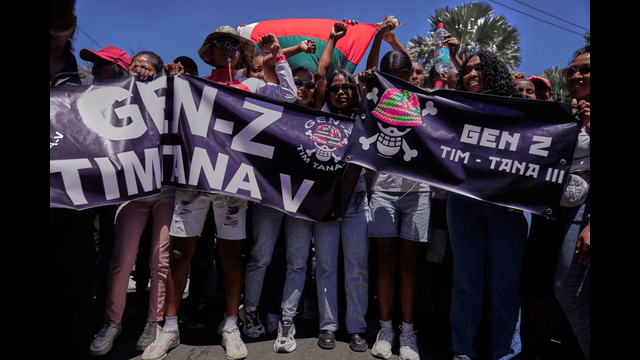
Protesters call for President Andry Rajoelina to step down in Antananarivo, Madagascar, Tuesday, Oct. 14, 2025.
Madagascar’s President Andry Rajoelina has been ousted in a military coup, marking yet another chapter of political instability for the island nation. The coup followed weeks of youth-led protests over widespread poverty, power outages, and lack of opportunities in one of Africa’s poorest countries.
The crisis reached a boiling point Tuesday after parliament voted to impeach Rajoelina, who fled the country fearing for his life. Hours later, Colonel Michael Randrianirina, head of the elite CAPSAT military unit, announced that the armed forces were seizing power and forming a transitional council.
Military Declares Control, Suspends Constitution
Speaking before cheering crowds outside the presidential palace in Antananarivo, Col. Randrianirina said the military would form a council of officers from the army and gendarmerie. The council, he added, would appoint a prime minister to quickly establish a civilian government.
“We are taking power,” Randrianirina declared, confirming that Madagascar’s constitution and High Constitutional Court had been suspended. He also announced plans for a national referendum within two years, without elaborating on what it would entail.
Rajoelina’s Attempt to Dissolve Parliament Fails
From an undisclosed location, Rajoelina issued a decree attempting to dissolve the lower house of parliament — a move seen as a last-minute attempt to cling to power. Lawmakers ignored the order and voted overwhelmingly to remove him from office.
In a statement, Rajoelina’s office condemned the military’s move as an “illegal declaration” and a “serious breach of the rule of law.” The statement read, “The Republic of Madagascar cannot be taken hostage by force. The State remains standing.”
A Nation Struggling With Poverty and Instability
Madagascar, a nation of nearly 30 million people, is the world’s largest producer of vanilla and famous for its unique biodiversity. Yet, since gaining independence from France in 1960, it has endured repeated coups and economic crises.
According to the World Bank, more than 75% of Malagasy citizens live in poverty. The recent protests, initially triggered by frequent electricity and water outages, soon grew into a broader movement against corruption, unemployment, and inequality.
Gen Z Protesters Demand Change
The protest movement was largely driven by young Malagasy citizens, many of whom are part of Generation Z. They have spent weeks rallying in the streets, demanding accountability and opportunity.
“If Madagascan children are studying in darkness, where is the future of this nation?” asked protester Soavololona Faraniaina. “We deserve better from our leaders.”
The protests took inspiration from other Gen Z-led uprisings in Nepal and Sri Lanka, movements that succeeded in removing their leaders. Though the demonstrations in Madagascar had no clear leadership, their message was united — the nation needs change.
Military Forces Once Helped Rajoelina Rise
Ironically, the same CAPSAT unit that toppled Rajoelina this week was instrumental in bringing him to power in 2009 during another military-backed coup. Over the weekend, CAPSAT announced it had assumed control of all armed forces, replacing the heads of the military and gendarmerie.
Initially, the unit denied staging a coup, claiming the people should decide the country’s future. However, its influence over government functions since Saturday made its power apparent.
Rajoelina, in a video statement before fleeing, described the situation as “a rebellion” and “an attempt to seize power illegally and by force.”
Madagascar Faces an Uncertain Future
As soldiers celebrated with protesters in the capital, the mood was a mix of relief and uncertainty. While many welcomed the president’s removal, others fear the coup could deepen Madagascar’s instability.
The coming weeks will determine whether the military council honors its promise to form a civilian-led government or follows the pattern of Madagascar’s turbulent political past.
For now, the youth-led uprising that began over blackouts and water shortages has rewritten the nation’s political future — but whether it leads to democracy or more disruption remains to be seen.