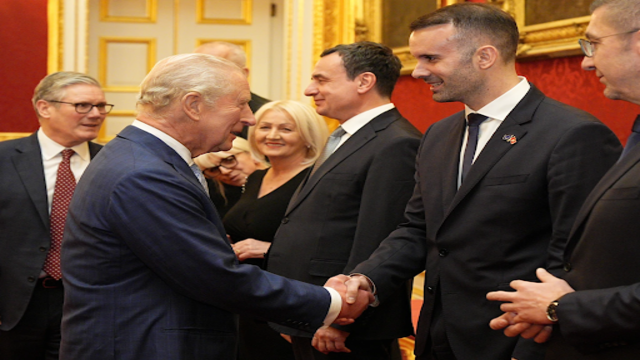
British king Charles III greets the prime minister Montenegro Milojko Spajic, during a reception for western Balkans leaders at Saint James Palace. Associated Press
Leaders from six Western Balkan nations gathered in London on Wednesday to discuss migration, regional security, and economic cooperation. The high-level meeting, hosted by the United Kingdom, comes amid growing European concerns about Russia’s influence and the ongoing migration crisis affecting the continent.
The summit is part of the Berlin Process, launched in 2014 to support the Western Balkans’ path toward European Union membership. Delegations from Albania, Bosnia, Kosovo, Montenegro, North Macedonia, and Serbia attended the meeting, alongside British and EU officials.
Renewed EU Focus on the Western Balkans
Since Russia’s invasion of Ukraine in 2022, the European Union has shown a renewed willingness to expand eastward. The conflict has underscored the importance of strengthening stability in regions vulnerable to outside influence.
While Croatia joined the EU in 2013, other Western Balkan countries remain in various stages of accession. Progress has been uneven, hindered by political disputes, corruption, and ongoing tensions — particularly between Serbia and Kosovo, whose independence Serbia still refuses to recognize.
The region remains strategically important for Europe, both as a potential EU member bloc and as a buffer against Russian political and economic interference.
UK’s Return to Regional Diplomacy
Although the UK left the EU in 2020, it continues to play an active diplomatic role in European security. The London Summit marks Britain’s ongoing commitment to stability in the Western Balkans.
Prime Minister Keir Starmer’s government is focusing on strengthening defenses against Russian influence, combating organized crime, and addressing illegal migration. A key priority for London is to build on existing cooperation with Balkan nations to disrupt smuggling networks and enhance border security.
Tackling Migration Through Cooperation
Migration remains one of the most pressing issues on the agenda. In recent years, hundreds of thousands of migrants have crossed into the EU via the Western Balkan route, often facilitated by criminal gangs.
British officials estimate that one in four migrants arriving in the UK via small boats across the English Channel have traveled through this region. The UK hopes to replicate its successful joint task force with Albania, which has significantly reduced the number of Albanian migrants reaching Britain — from 12,000 in 2022 to just 600 in 2024.
The cooperation included returns agreements and local development projects in migrant-sending regions, offering an example of how targeted partnerships can deliver results.
Controversy Over “Return Hubs”
One of the most debated proposals discussed in London was the creation of “return hubs” — facilities to house migrants whose asylum claims have been rejected, pending deportation.
However, the idea has met strong opposition. Albanian Prime Minister Edi Rama dismissed the proposal outright, saying, “When it comes to the hubs, or whatever they are called, I’ve said it, and I repeat — never in Albania.”
Montenegro’s Prime Minister Milojko Spajic also expressed hesitation, noting that his country lies outside main migration routes due to poor railway infrastructure. He quipped that Montenegro might consider a returns hub only if Britain agreed to invest €10 billion in railway development.
A Push for Stability and Progress
Despite the disagreements, the London summit reflects a shared goal: ensuring stability and prosperity in the Western Balkans. Both the EU and the UK recognize that strengthening the region’s governance, security, and economic resilience is crucial for Europe’s long-term peace.
By deepening cooperation on migration control, law enforcement, and economic development, the Western Balkans and their European partners aim to build a more secure and connected future — one that resists external manipulation and supports regional growth.