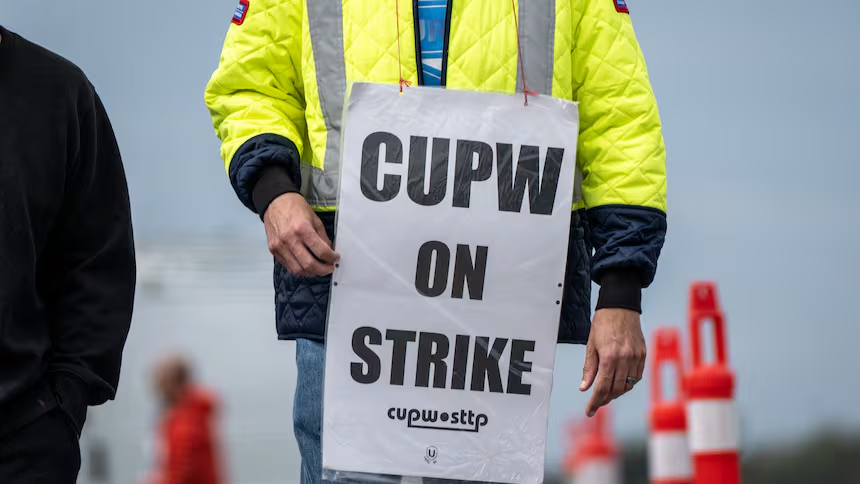
Canada Post workers are pictured on strike at the Canada Post processing centre in Richmond, B.C., on Sept. 26, 2025.
The Canada Industrial Relations Board (CIRB) has dismissed the Canadian Union of Postal Workers’ (CUPW) challenge against a government back-to-work order. The ruling confirms the federal government acted within its legal authority.
The dispute stems from a postal workers’ strike that began late last year. On December 13, 2024, Labour Minister Steve MacKinnon invoked Section 107 of the Canada Labour Code. This allowed him to direct the CIRB to end the strike and take over arbitration of the labour dispute.
CUPW argued the order was unconstitutional. The union claimed it violated workers’ Charter rights by restricting their ability to strike. However, the CIRB ruled that while the right to strike is essential, it is not absolute. The board concluded Section 107’s use did not breach the Charter and that it had no authority to review the minister’s decision.
Dissenting Voice on the Board
The CIRB’s decision was not unanimous. Board member Paul Moist issued a dissenting opinion. He sided with CUPW, calling the minister’s action “reverse engineering of the highest order.”
Moist argued that Section 107 was used for political convenience, bypassing parliamentary debate and public scrutiny. He emphasized that the back-to-work order restricted workers’ right to strike and undermined meaningful collective bargaining, which he believes violates the Charter.
CUPW has also filed for judicial review, though the federal court has not yet issued a ruling. The CIRB officially notified all parties on August 13. The decision became publicly available after translations were completed.
Controversial Use of Labour Code
The use of Section 107 has drawn strong criticism from unions. They argue it sets a dangerous precedent by allowing the government to intervene in labour disputes.
Union leaders say this provision discourages employers in federally regulated industries from engaging sincerely in negotiations. Critics also argue it weakens the government’s ability to resolve strikes effectively.
While Section 107 has existed since 1984, it was rarely used for decades. Recently, however, the Liberal government has invoked it multiple times.
Recent Strikes Affected
The provision has impacted several high-profile labour disputes. In 2023, Labour Minister Patty Hajdu used Section 107 to end an Air Canada flight attendants strike just hours after it began. The union, however, ignored the order.
The government has also applied Section 107 in strikes involving Canada’s largest railway companies, ports in Montreal and Vancouver, and Canada Post. Each instance has sparked debate over workers’ rights and government overreach.
Unions argue these interventions undermine workers’ ability to negotiate freely and create an uneven power balance in federally regulated workplaces. Meanwhile, the government maintains it is acting within legal limits to ensure essential services continue uninterrupted.
What Lies Ahead
With the CIRB ruling, CUPW faces a major setback in its legal battle. Yet the union’s judicial review request leaves the final outcome uncertain. Labour experts predict ongoing tension between unions and the federal government over Section 107.
As debates continue, workers’ rights and government authority remain at the center of Canada’s labour landscape. This case underscores the delicate balance between protecting essential services and respecting employees’ fundamental rights.