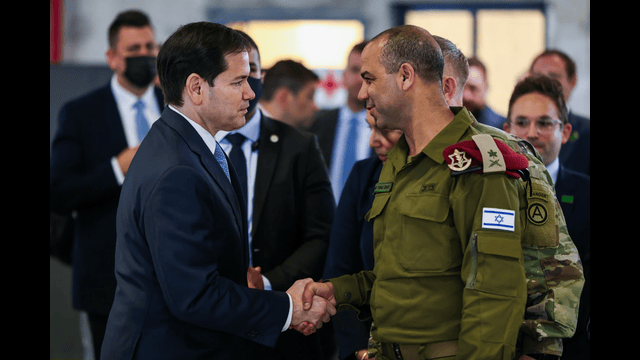
US Secretary of State Marco Rubio speaks with Israeli Brigadier General Yaakov Dolf as he visits the Civil-Military Coordination Center in Southern Israel, Friday, Oct. 24, 2025.
U.S. Secretary of State Marco Rubio visited Israel on Friday to tour a U.S.-led coordination center overseeing the fragile Gaza ceasefire. The visit marked another major step by Washington to maintain calm between Israel and Hamas while laying the groundwork for Gaza’s long-term stability and reconstruction.
Rubio’s visit follows those of U.S. Vice President JD Vance, who inaugurated the center earlier this week, and presidential envoys Steve Witkoff and Jared Kushner. The steady stream of top American officials underscores the Biden administration’s — now Trump administration’s renewed — commitment to ensuring the truce holds.
U.S.-Led Coordination Center Gears Up for Gaza Stabilization
Around 200 American troops are stationed at the southern Israel center, working alongside Israeli forces and representatives from several nations, including France, Germany, Greece, Australia, and Canada. Their mission: to design strategies for Gaza’s stabilization and eventual reconstruction.
“I think we have a lot to be proud of in the first 10 to 12 days of implementation,” Rubio said during the visit, acknowledging the early challenges faced by the coordination team.
He announced that U.S. Ambassador to Yemen, Steven Fagin, will head the civilian operations, while Admiral Brad Cooper of the U.S. Central Command will lead the military side.
Building Global Support for Gaza Security
Rubio’s visit also focused on securing international backing for a new Gaza stabilization force. The proposed coalition aims to train a Palestinian security unit and ensure peace in the volatile region.
According to Rubio, Washington is exploring possible United Nations authorization to legitimize the force, as several nations require such a mandate before committing troops. “Countries need clarity — their command structure, mandate, and who’s in charge,” Rubio explained, emphasizing that Israel’s approval of participant nations remains essential.
Rubio’s meetings in Jerusalem included discussions with Israeli Prime Minister Benjamin Netanyahu. Local media humorously referred to the flurry of American diplomatic visits as “Bibi-sitting,” a nod to Netanyahu’s nickname and a past campaign slogan portraying him as Israel’s trusted caretaker.
Life Amid the Ruins in Gaza
While leaders discuss ceasefire logistics, ordinary Gazans continue struggling to rebuild their shattered lives. Many have returned home only to find rubble and despair.
“I couldn’t find any place other than here,” said Kamal Al-Yazji, whose three-story home in Gaza City was destroyed. “Every day, I sit in front of the ruins and feel sorrow.” His family now lives in a makeshift tent, battling mosquitos, hunger, and exhaustion.
Nearby, Umm Muhammad al-Araishi wandered through what was once her neighborhood, trying to locate familiar landmarks. “I couldn’t recognize the place,” she said. “Even the hospital I used to visit is gone.”
Humanitarian Efforts Without UNRWA
Rubio revealed that up to a dozen international groups — including U.N. agencies and other humanitarian organizations — will join the aid effort in Gaza. However, he made it clear that UNRWA, the United Nations Relief and Works Agency, would be excluded from U.S.-backed operations.
“The United Nations is here, and we’re ready to work with them if they can make it work — but not UNRWA,” Rubio stated. “UNRWA became a subsidiary of Hamas.”
The comment came days after the International Court of Justice ordered Israel to allow UNRWA to deliver aid to Gaza. Despite the ruling, Israel has blocked the agency’s supply convoys since March. Still, UNRWA continues to provide limited health, education, and sanitation services through its local staff.
The agency says over 6,000 aid trucks remain stalled outside Gaza, awaiting clearance. Israel’s government, led by Netanyahu and his far-right allies, accuses UNRWA of harboring Hamas influence — a charge the organization denies.
Moving Forward: Balancing Ceasefire and Reconstruction
Rubio’s tour of the coordination center signals Washington’s deep involvement in shaping post-war Gaza. While the ceasefire has brought temporary calm, both the U.S. and its allies face an uphill task: balancing Israel’s security concerns with Gaza’s humanitarian and reconstruction needs.
As diplomacy unfolds and debris clears, the world watches closely — hoping the fragile truce evolves into lasting peace.