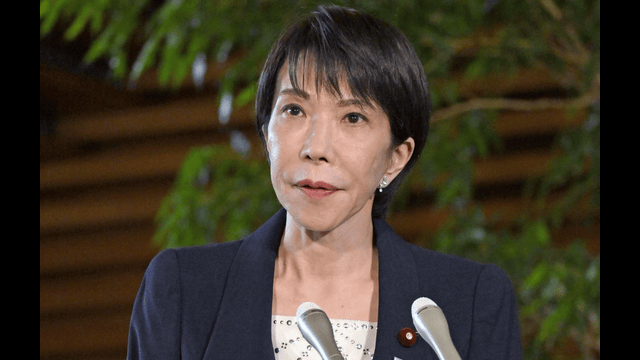
Japan’s new Prime minister Sanae Takaichi speaks to the media at the prime minister's office in Tokyo.
Japan’s newly appointed Prime Minister, Sanae Takaichi, is stepping straight into a diplomatic storm. Barely a week into her tenure, she faces back-to-back foreign policy challenges — from managing U.S. President Donald Trump’s unpredictability to calming China’s suspicions about her hawkish stance.
Her debut week is a whirlwind of diplomacy. She starts in Malaysia for Southeast Asian talks, returns to Tokyo for her first meeting with Trump, and then flies to South Korea for the Asia-Pacific Economic Cooperation (APEC) summit. Each stop will test her leadership, strategic vision, and ability to balance Japan’s global relationships.
Balancing Trump’s Demands and China’s Distrust
Takaichi steps into the spotlight with limited foreign policy experience. Yet, she must immediately navigate tensions between Japan’s strongest ally, the U.S., and its powerful neighbor, China.
Beijing remains wary of her right-wing political stance and her vocal support for strengthening Japan’s military. China also remembers her controversial comments defending Japan’s wartime actions — a sensitive issue that continues to cloud bilateral relations.
Adding to the tension, neither President Xi Jinping nor Premier Li Qiang has congratulated Takaichi on her appointment, a cold contrast to their swift acknowledgment of her moderate predecessor, Shigeru Ishiba.
Military Spending: A Move to Impress Washington
In her first policy address, Takaichi vowed to increase Japan’s defense spending to 2% of GDP by March, two years ahead of schedule. The decision is seen as a strategic effort to please Trump, who has repeatedly pressed U.S. allies to contribute more to their defense.
“In our region, China, North Korea, and Russia’s military activities pose serious concerns,” she told lawmakers.
While this move could strengthen ties with the U.S., it risks deepening rifts with China, which views Japan’s military expansion as a threat. Analysts believe Trump’s focus during his Tokyo visit will likely shift toward economic cooperation and investment in American manufacturing, aligning with his agenda to create U.S. jobs.
Lessons from Abe: Walking a Tightrope
Takaichi is considered a political protégé of former Prime Minister Shinzo Abe, who managed to earn Trump’s trust while maintaining cautious ties with China. Experts suggest she might try to follow his diplomatic playbook — a balance between military assertiveness and strategic restraint.
Her strong nationalist views are well known. Before taking office, she regularly visited the Yasukuni Shrine, which honors Japan’s war dead — including convicted war criminals. These visits have long angered both China and South Korea.
However, she notably skipped the shrine’s autumn festival this year, signaling a possible shift in tone. Analysts say she will likely avoid such visits to prevent diplomatic backlash that could destabilize her fragile coalition government.
“It would be foolish for her to provoke a major diplomatic incident in her first year,” noted Gerald Curtis, a Japanese politics expert at Columbia University. He added that her nationalist supporters already trust her ideological stance, making symbolic gestures unnecessary.
China Still Skeptical of Takaichi’s Intentions
Despite her statements about wanting “stable relations” with China, experts remain doubtful. Lian Degui, a scholar from Shanghai International Studies University, said, “If she learns from Abe, relations won’t worsen. Abe rarely visited Yasukuni as prime minister, and that restraint built a base for dialogue.”
Others are less optimistic. Shi Yinhong, a professor at Renmin University in Beijing, predicts rising military tensions under Takaichi’s leadership. Disputes over history and security are likely to intensify, he warned.
Another analyst, Liu Jiangyong from Tsinghua University, suggested that while a brief greeting with Chinese leaders during the upcoming summit might occur, a formal meeting is unlikely due to Takaichi’s past rhetoric and her drive for military expansion.
A Diplomatic Test That Defines Her Leadership
As Prime Minister Sanae Takaichi embarks on her whirlwind diplomatic tour, her challenge is clear — strengthen Japan’s alliance with the U.S. without alienating China. Every decision she makes in these early days will shape Japan’s foreign policy direction and her credibility as a global leader.
Her packed first week on the world stage isn’t just a test of diplomacy — it’s a defining moment for Japan’s future balance between power, politics, and peace.