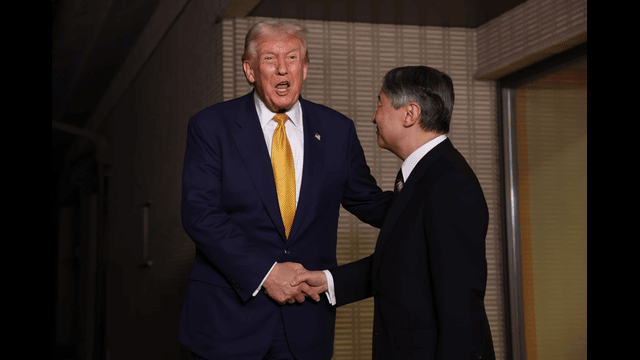
President Donald Trump, left, and Japan’s Emperor Naruhito shake hands during their meeting at the Imperial Palace in Tokyo, Oct. 27, 2025.
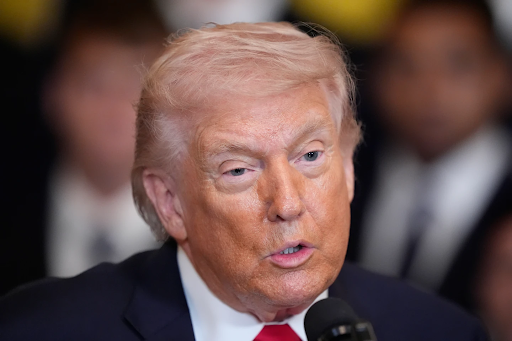
President Donald Trump began his Tuesday in Tokyo with a warm welcome for Japan’s new Prime Minister, Sanae Takaichi, marking the start of one of the busiest days of his Asia tour. His visit included meetings with U.S. troops aboard an aircraft carrier and top business leaders.
Although Japan remains one of America’s strongest allies, Trump’s visit comes at a time of uncertainty — both politically and economically.
A Historic Meeting Between Allies
Prime Minister Takaichi, Japan’s first female leader, met Trump at Tokyo’s Akasaka Palace just days after assuming office. Their meeting aimed to strengthen bilateral ties and economic cooperation.
As they shook hands, Trump remarked, “That’s a very strong handshake,” earning smiles from both sides.
Takaichi expressed admiration for Trump’s diplomatic approach and fondly recalled former Prime Minister Shinzo Abe — her political mentor — who shared a strong relationship with Trump through their mutual love for golf.
The Japanese leader also announced a symbolic gesture: Japan would gift 250 cherry trees to the U.S. in 2026, celebrating America’s 250th anniversary, along with fireworks from Akita Prefecture for the Fourth of July celebrations.
Trump praised Takaichi’s rise to leadership, calling it a “big deal,” and reaffirmed Washington’s unwavering commitment to Japan. “Anything I can do to help Japan, we will be there,” he said. “We are an ally at the strongest level.”
Trade and Investment Take Center Stage
At the core of the discussions was a new economic framework involving a $550 billion Japanese investment in the United States. The leaders signed a short but significant agreement, confirming U.S. import taxes on Japanese goods at 15% and marking the beginning of what both described as a “golden age” of partnership.
A second agreement focused on securing critical minerals and rare earth supplies, essential for advanced technologies. This move indicated a mutual effort to stabilize global supply chains and reduce dependence on China.
A Charm Offensive with a Strategic Touch
Takaichi used the meeting to highlight Japan’s intent to strengthen trade ties — even hinting at purchasing Ford F-150 trucks. Outside the venue, reporters noticed a gold-toned Ford F-150 and American-made Toyota cars, symbolizing potential trade shifts.
Trump, who has often criticized Japan for not buying enough American vehicles, seemed pleased with the gesture.
White House Press Secretary Karoline Leavitt later revealed that Takaichi would nominate Trump for the Nobel Peace Prize, a move seen as a diplomatic compliment to the U.S. leader.
Lunch Diplomacy and Global Concerns
During a working lunch, the Japanese delegation served American beef and rice with Japanese ingredients — another symbolic nod to cooperation. The leaders also discussed the war in Ukraine and efforts to maintain regional stability.
They met with families of Japanese citizens abducted by North Korea, reaffirming their shared stance against Pyongyang’s human rights violations.
Focus on Asia’s Stability and Future
Trump’s Asia trip underscores his focus on strengthening alliances through trade, defense, and diplomacy. Before Japan, he attended the ASEAN Summit in Kuala Lumpur, where he mediated a ceasefire between Thailand and Cambodia.
In Tokyo, he plans to address U.S. troops aboard the USS George Washington, reinforcing America’s commitment to regional security.
Meanwhile, anticipation is building for Trump’s upcoming meeting with Chinese President Xi Jinping in South Korea. Both nations are reportedly nearing a trade deal, signaling an effort to ease tensions between the world’s two largest economies.
However, details remain unclear. Analysts say the agreement may not fully resolve the long-standing trade disputes but could prevent another round of damaging tariffs.
Looking Ahead
Trump’s Japan visit emphasized mutual respect, economic partnership, and strategic cooperation in the Indo-Pacific. His praise for Takaichi’s leadership marked a new chapter in the U.S.-Japan relationship.
As Trump prepares to leave for South Korea to attend the Asia-Pacific Economic Cooperation Summit, the message from Tokyo is clear — the alliance between the U.S. and Japan remains strong, forward-looking, and built on shared democratic values.