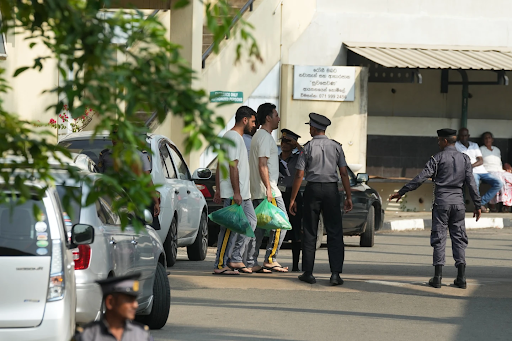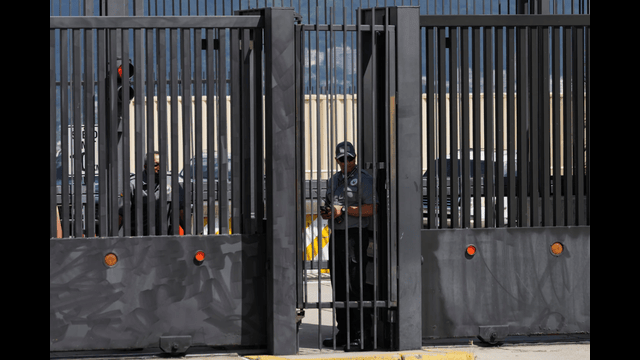
Security officers stand behind the main gate of the United States embassy in Caracas, Venezuela , Oct 27, 2025.
Venezuela has suspended its decade-old energy agreements with Trinidad and Tobago after the island nation hosted a U.S. warship. The move, announced by President Nicolás Maduro, marks a new flashpoint in the strained relations between Caracas and Washington’s Caribbean allies.
Maduro Accuses Trinidad of Supporting U.S. “Hostility”
President Nicolás Maduro said on his weekly television show that Trinidad had become “an aircraft carrier of the U.S. empire.” His statement came after the arrival of the USS Gravely, a U.S. destroyer equipped with guided missiles, which docked in Trinidad on Sunday for joint naval exercises.
Maduro claimed the decision left him “no choice” but to withdraw from treaties signed with Trinidad ten years ago. The suspension followed recommendations from Venezuela’s Vice President and Hydrocarbons Minister, Delcy Rodríguez, who urged the government to cut ties over what she called “hostile actions.”
USS Gravely’s Visit Sparks Outrage in Caracas
Venezuelan officials denounced Trinidad’s hosting of the U.S. vessel as a direct provocation. They alleged it formed part of a wider American campaign targeting Venezuelan operations in the Caribbean.
The U.S. Navy has recently intensified its efforts to intercept Venezuelan speedboats allegedly carrying drugs to the United States. However, Trinidad maintains that the exercises are part of regular military cooperation with Washington and are meant to strengthen internal security.
“The prime minister of Trinidad has decided to join the war-mongering agenda of the United States,” Rodríguez declared during a televised address.
Trinidad Responds: “Our Future Doesn’t Depend on Venezuela”
Prime Minister Kamla Persad-Bissessar downplayed the significance of Venezuela’s move. In messages to the Associated Press, she said Trinidad remained unfazed by the cancellation of the agreements.
“Our future does not depend on Venezuela and never has,” Persad-Bissessar stated. She added that the joint exercises were solely for “internal security” and that the country had independent plans to grow its economy across both energy and non-energy sectors.
Energy Pact Withdrawal and Gas Exploration Impact
The suspended deal, signed in 2015, allowed both nations to jointly explore natural gas in the waters separating them. The maritime border between Venezuela and Trinidad is only seven miles wide at its narrowest point.
Rodríguez confirmed she had officially requested Maduro to pull out of the agreement, citing national sovereignty and security concerns. The decision could affect future exploration projects in the region, which has been a key area for shared energy investments.
Drug War Adds Fuel to Regional Tensions
Prime Minister Persad-Bissessar has supported the controversial U.S. campaign to destroy alleged drug-carrying vessels. Unlike some Caribbean leaders who have condemned the strikes as “extrajudicial killings,” she defended them, saying she would “rather see drug traffickers blown to pieces” than allow them to terrorize her citizens.
“I am tired of seeing our people murdered and terrorized by gang violence linked to illegal drugs and arms trafficking,” she told AP.
Trinidad, home to about 1.4 million people, has long been a strategic transit point for smugglers transporting drugs to Europe and North America.
U.S. Military Buildup Deepens Venezuela’s Concerns
Venezuela has condemned the U.S. military’s growing presence in the Caribbean as a threat to its sovereignty. Officials in Caracas believe the deployment is part of an effort to overthrow Maduro, who has faced international criticism for allegedly rigging last year’s election.
The tension escalated after the U.S. announced it would send its largest aircraft carrier to the southern Caribbean. The deployment now includes eight warships, a submarine, drones, and fighter jets.
Since September, the U.S. has launched ten strikes against suspected drug vessels, resulting in at least 43 deaths. The operations have been praised by Washington but heavily criticized by regional governments and human rights groups.
A Growing Rift in the Caribbean
Venezuela’s decision to cut energy ties underscores the growing polarization in the region. While Trinidad strengthens security cooperation with the U.S., Caracas continues to view such alliances as threats to its stability.
As both nations double down on their positions, the suspension could reshape diplomatic and economic relations across the Caribbean, with ripple effects on energy, security, and regional unity.