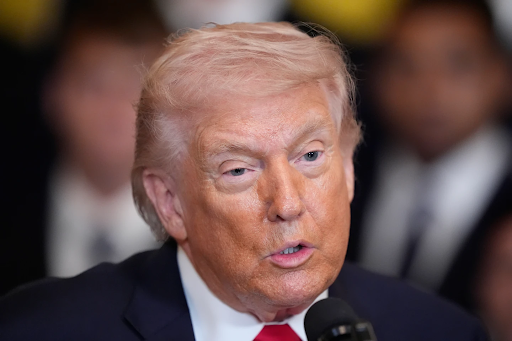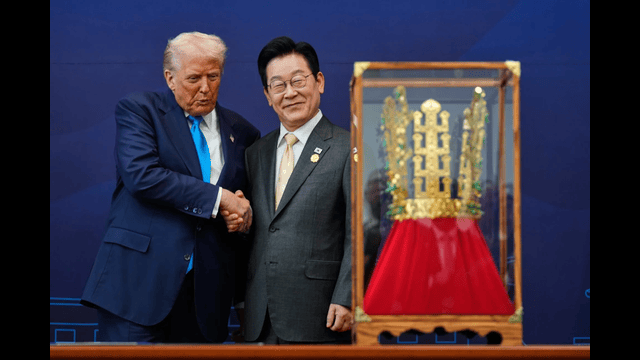
President Donald Trump shakes hands with South Korean President Lee Jae Myung as he receives a gift of a gold crown and an award of the Grand Order of Mugunghwa, not seen, during a high honor ceremony at the Gyeongju National Museum in Gyeongju, South Korea, Wednesday, Oct. 29, 2025.
In a major defense development, the United States plans to share nuclear-powered submarine technology with South Korea. Former President Donald Trump revealed the decision on social media after his meeting with South Korean President Lee Jae Myung.
The move, if finalized, could reshape the security dynamics in the Indo-Pacific, strengthening Seoul’s defense capabilities and expanding Washington’s influence in the region.
South Korea Aims to Modernize Military Alliance
During their Wednesday meeting, President Lee emphasized South Korea’s commitment to modernizing its alliance with the U.S. He noted that Seoul would boost military spending to reduce the financial burden on Washington.
Lee clarified that previous talks about nuclear-powered submarines were misunderstood. “We are seeking nuclear fuel, not nuclear weapons,” he said. The goal, according to Lee, is to enhance operational efficiency, not escalate nuclear armament.
Why South Korea Wants Nuclear-Powered Submarines
South Korea’s current fleet of diesel-powered submarines has significant limitations. These submarines must surface frequently to recharge batteries, exposing them to detection and reducing endurance.
In contrast, nuclear-powered submarines can stay submerged for months, travel farther, and track enemy submarines more effectively. President Lee argued that these advanced vessels would allow South Korea to better support U.S. naval operations in the Indo-Pacific region.
Trump Reveals Key Partnership Details
Trump stated that South Korea would build its first nuclear-powered submarine at the Philly Shipyard in the United States. The shipyard, now owned by South Korea’s Hanwha Group, was purchased last year as part of a major expansion in defense cooperation.
Though the scale and cost of the submarine project remain unclear, Seoul has reportedly committed around $150 billion to boost America’s shipbuilding capacity. This investment signals South Korea’s intent to become a long-term strategic defense partner.
A Rare Move by Washington
The U.S. has traditionally been extremely cautious about sharing nuclear submarine technology. The technology is among the most sensitive and classified within the American defense system.
Even in the AUKUS alliance—a defense pact between the U.S., U.K., and Australia—the U.S. has avoided directly transferring its core nuclear propulsion technology. Trump’s announcement, therefore, marks a surprising and unprecedented step in U.S. foreign policy.
Timing and Geopolitical Implications
Trump’s statement came just before his scheduled meeting with Chinese President Xi Jinping. China, which already operates nuclear-powered submarines, has been expanding its naval presence in the South China Sea and beyond.
The timing also coincides with growing threats from North Korea, which recently unveiled its first nuclear-powered submarine under construction. North Korea has been ramping up missile tests, with the latest cruise missile launches occurring just as Trump visited Seoul.
Defense analysts say these developments could push the Korean Peninsula into a new phase of maritime competition, with potential ripple effects across Asia.
Pentagon’s Silence Raises Questions
Despite Trump’s announcement, Pentagon officials have not yet commented on the plan to share nuclear submarine technology with South Korea. The lack of confirmation has sparked debate over whether this is an official policy shift or a premature statement by Trump.
If implemented, the deal could redefine U.S.–South Korea defense cooperation and set a new precedent for how Washington shares its most advanced military technologies.