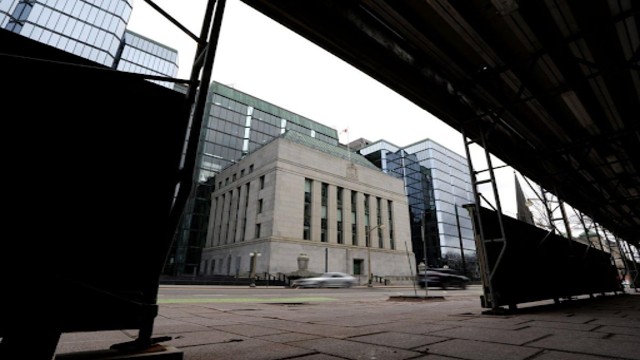
The Bank of Canada is seen in Ottawa, on Wednesday, April 16, 2025. The Canadian Press
The Bank of Canada has reduced its benchmark interest rate for the second time in a row, bringing the overnight rate down to 2.25 per cent.
The move, expected by most economists, aims to support an economy struggling under trade uncertainty, slowing exports, and rising costs. Policymakers said the decision reflects weaker-than-expected growth and inflation projected to stay near the two per cent target.
Macklem Warns of a “Structural Transition”
Speaking in Ottawa, Bank of Canada Governor Tiff Macklem said the rate cuts — totalling one percentage point since January — are designed to help the economy navigate what he called a “period of adjustment.”
Macklem pointed to the growing impact of U.S. tariffs and ongoing trade uncertainty, saying they’ve weakened Canada’s economic performance while adding costs for many businesses.
“The weakness we’re seeing in the Canadian economy is more than just cyclical,” he said. “It’s also a structural transition.”
U.S. Tariffs Deepen the Slowdown
The latest rate decision follows fresh trade turbulence. Over the weekend, U.S. President Donald Trump announced an additional 10 per cent tariff on Canadian goods, escalating tensions just as hopes for a trade deal had faded.
The surprise move has shaken confidence among Canadian exporters already hit by earlier duties and by Washington’s abrupt halt to trade talks after Ontario’s anti-tariff campaign.
Macklem said the central bank might pause further cuts if the economy performs as forecast. “If growth evolves in line with our outlook, the current rate should help maintain inflation near target,” he said. But he added that forecasts remain uncertain in today’s unpredictable trade climate.
Trade Conflict Weighing on Growth
In its Monetary Policy Report, the central bank warned that U.S. trade actions would leave a lasting mark on Canada’s economy. The report showed that trade tensions earlier this year led to lower GDP, weaker exports and business investment, and higher unemployment.
“The entire GDP path is lower than before the U.S. policy shift,” Macklem said, though he expects growth to pick up gradually in 2026.
In the second quarter alone, Canada’s GDP shrank 1.6 per cent. Steel and aluminum exports plunged 25 per cent from a year earlier, while total exports fell five per cent. Spending on industrial machinery and equipment also saw the sharpest decline.
Inflation Rises but Within Target
Despite the slowdown, consumer prices have ticked upward. Annual inflation rose to 2.4 per cent in September from 1.9 per cent in August, driven by higher gasoline and grocery prices. Core inflation, excluding volatile items, remains around three per cent — within the bank’s comfort zone.
The central bank expects inflation to stabilize at two per cent in early 2026 and remain steady through 2027. It also reaffirmed its readiness to “respond as needed” if inflation drifts off track.
Outlook: Slower Growth Ahead
The Bank of Canada forecasts GDP to be about 1.5 per cent — roughly $40 billion — lower by the end of 2026 compared to earlier projections. Growth is expected to average just 1.4 per cent over 2026 and 2027, with export recovery starting only in 2026.
Imports and exports are both projected to fall through 2025 as tariffs and weaker U.S. demand take hold. Global economic growth, meanwhile, is expected to slow to around three per cent over the next two years.
The federal government’s first budget under Prime Minister Mark Carney is due next week and is expected to include new defence spending and fiscal restraint. The Bank of Canada’s next interest rate decision is scheduled for December 10.