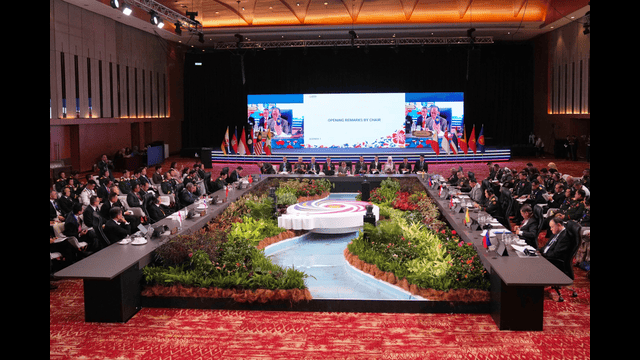
Ministers and members of the delegates attend the opening session of the ASEAN.
U.S. Defense Secretary Pete Hegseth reaffirmed Washington’s firm stance on defending its interests in the Indo-Pacific during high-level talks with Chinese and Indian defense officials in Malaysia on Friday. His remarks came as tensions in the region continue to grow over territorial disputes and strategic rivalries.
Firm Message to China on Regional Balance
Hegseth described his meeting with Chinese Defense Minister Admiral Dong Jun as “good and constructive.” The dialogue took place on the sidelines of the ASEAN Defense Ministers’ Meeting in Kuala Lumpur.
He said he expressed serious concerns over China’s actions in the South China Sea, around Taiwan, and toward U.S. allies in the region.
“I highlighted the need to maintain a balance of power in the Indo-Pacific,” Hegseth said on X. “The United States does not seek conflict, but it will firmly defend its interests and maintain strong capabilities in the region.”
China Stresses Its Position on Taiwan
China’s Defense Ministry issued a cautious response, reiterating its established stance on Taiwan. Dong Jun called Taiwan’s reunification with China an “unstoppable historical trend” and urged the U.S. to act with caution.
The ministry’s statement added that Beijing hopes Washington will translate its words of “not seeking conflict” into action and contribute positively to regional peace and stability.
This meeting followed a video call between the two defense leaders on September 9. Despite ongoing diplomatic engagement, sharp differences remain, especially concerning Taiwan and freedom of navigation in the Indo-Pacific.
New 10-Year Defense Pact Strengthens U.S.-India Ties
Hegseth also met with India’s Defense Minister Rajnath Singh, where both sides signed a 10-year defense framework aimed at deepening military and technological collaboration.
The agreement is seen as a major step in enhancing the U.S.-India defense partnership, a relationship both nations view as vital for maintaining stability in the Indo-Pacific.
“This advances our defense partnership, a cornerstone for regional stability and deterrence,” Hegseth posted on X. Singh echoed similar sentiments, saying the pact “signals our growing strategic convergence” and “heralds a new decade of partnership.”
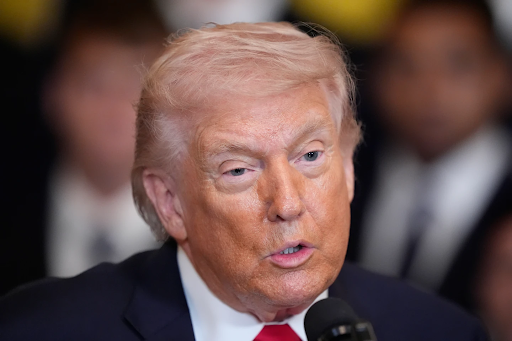
However, the signing comes amid renewed trade strains after President Donald Trump imposed a 50% import tariff on Indian goods and criticized India’s continued purchase of discounted Russian oil. India remains the second-largest buyer of Russian oil after China.
Commitment to Maritime Security in Southeast Asia
In separate meetings with his Malaysian and Philippine counterparts, Hegseth reaffirmed America’s commitment to maritime security in the South China Sea.
He said the U.S. will “work relentlessly to reestablish deterrence” in the region.
Malaysia has often raised concerns about Chinese vessel incursions into its waters but prefers quiet diplomacy. The Philippines, by contrast, has faced open confrontations with China over maritime boundaries.
ASEAN Voices Concern Over U.S. Nuclear Testing Plans
Discussions also touched on President Donald Trump’s recent comments about restarting U.S. nuclear weapons testing after three decades.
Malaysian Defense Minister Mohamed Khaled Nordin reminded reporters that ASEAN is a nuclear-weapon-free zone and warned against any actions that could “bring great calamity to humankind.”
ASEAN Secretary-General Kao Kim Hourn said member states may seek clarification from Hegseth during Saturday’s ASEAN-U.S. meeting.
“For global safety, it’s vital to ensure the world never witnesses another use of nuclear weapons,” he stated.
Regional Talks Continue
The ASEAN defense ministers are scheduled to continue discussions with dialogue partners including the United States, China, India, Japan, Australia, South Korea, and Russia.
These meetings aim to strengthen regional security cooperation and prevent escalation in the Indo-Pacific, a region increasingly central to global power dynamics.