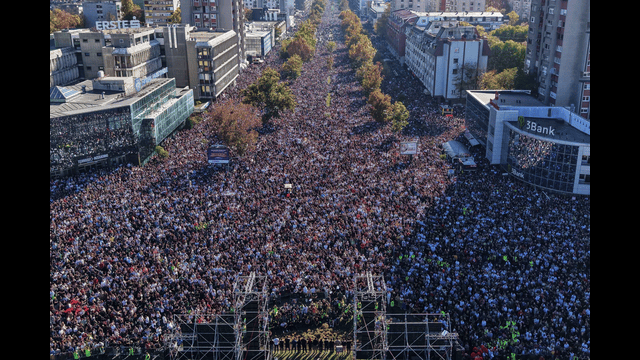
People fill the streets near a train station before observing 16 minutes of silence for the victims on the first anniversary of the disaster that killed 16 people.
Tens of thousands of Serbians gathered in Novi Sad on Saturday to remember the victims of last year’s tragic train station collapse. The emotional event also became a powerful call for justice and political accountability in a country still reeling from the disaster.
The collapse of a concrete canopy at Novi Sad’s railway station on November 1, 2023, killed 16 people and injured dozens. One year later, grief has turned into a nationwide movement challenging President Aleksandar Vucic’s government and its handling of public safety and corruption.
A Nation Mourns — and Demands Answers
The ceremony began at exactly 11:52 a.m., the time of the collapse, with 16 minutes of silence to honor each victim. Later, the crowd observed another 16-minute silence at sunset, closing the rally in a moment of collective reflection.
Attendees placed wreaths, lit candles, and held signs demanding justice. Many wore red handprints — a now-symbolic protest image representing “blood on the government’s hands.”
University student Nadja Solaja, a leading protester, told the crowd, “This was not an accident. It was a crime — a murder caused by corruption.”
The protesters claim the station’s renovation, done under contracts linked to Chinese firms, was rushed and riddled with corruption. Despite 13 people being charged, no one has been held accountable.
Heartbroken Families Demand Justice
For grieving parents, the pain remains raw. Dijana Hrka, whose son Stefan was among the victims, announced she would begin a hunger strike in Belgrade. “I must know who killed my child,” she said tearfully. “Someone must answer for this.”
Many in the crowd echoed her demand, chanting for accountability and transparency in state projects. They accuse the government of prioritizing political alliances and foreign deals over public safety.
Students Lead a Movement for Change
The youth-led movement that emerged after the tragedy continues to grow. Students from across Serbia organized the anniversary event, carrying a banner that read: “See you tomorrow and every other day until there is justice.”
For weeks leading up to the rally, hundreds of students marched from different cities to Novi Sad — some walking over 400 kilometers to join the commemoration. They were greeted with applause, tears, and embraces as they arrived.
“We’re not just here to mourn,” said one student leader. “We’re here to change the country.”
Vucic’s Apology Fails to Ease Public Anger
President Aleksandar Vucic, who attended a church service in Belgrade instead of the rally, issued a rare apology on Friday. In a televised address, he admitted, “I have said some things that I am now sorry for saying,” referring to his earlier remarks calling student protesters “terrorists.”
He urged dialogue and promised to “seek truth through institutions,” but few were convinced. Protesters dismissed his apology as political damage control. Many noted that authorities even suspended train services to Novi Sad during the rally — a move seen as an attempt to block attendance.
Meanwhile, the government declared a national day of mourning, but critics called it a symbolic gesture without accountability.
European Union Voices Support
The tragedy has drawn international attention. Marta Kos, the EU Commissioner for Enlargement, posted on X (formerly Twitter) that the canopy collapse “is changing Serbia.”
“It has moved citizens to stand for accountability, free expression, and inclusive democracy — the same values guiding Serbia’s EU path,” she wrote.
Serbia at a Crossroads
Serbia’s path to the European Union remains uncertain. While the government claims progress, critics argue that Vucic’s ties with Russia and China and his crackdown on dissent are holding the nation back.
The Novi Sad rally was more than a memorial — it was a statement of unity, courage, and resistance. For many Serbians, the message was clear: justice for the victims must come before political power.
As the night ended with candles flickering across the square, one phrase echoed through the crowd — “We will not forget, and we will not stop.”