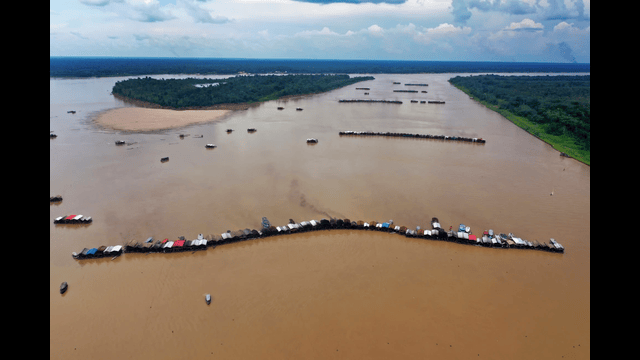
Dredging barges operated by illegal miners converge on the Madeira River, a tributary of the Amazon river, searching for gold, in Autazes, Amazonas state, Brazil, Nov. 25, 2021.
Brazilian authorities have launched one of the largest operations yet against illegal gold mining in the Amazon. Backed by Interpol, police dismantled hundreds of dredges along the Madeira River, striking a major blow to organized environmental crime.
277 Dredges Destroyed in Amazon Mining Sweep
In a sweeping crackdown, Brazil’s Federal Police destroyed 277 illegal floating mining rafts operating along the Madeira River. The dredges, used for gold extraction, were valued at nearly $6.8 million.
Interpol estimated the total financial loss to criminal networks at about $193 million, factoring in destroyed equipment, lost gold, and environmental damage. This operation marks one of the most extensive coordinated actions ever taken in the Amazon Basin.
Targeting the Heart of Amazon’s Illegal Mining Network
The Madeira River, one of the Amazon’s largest tributaries, stretches from the Andes through Bolivia into northern Brazil. For decades, this vast region has been a hotspot for illegal mining, pollution, and deforestation.
The recent raids, led by the Federal Police’s Amazon and Environment Protection Division, focused on a 400-square-kilometer area heavily scarred by gold mining. Satellite mapping helped officers pinpoint illegal dredges hidden deep within the rainforest.
Over 100 officers participated in the mission, supported by a new regional coordination center uniting several Amazonian law enforcement agencies.
Interpol’s Cross-Border Operation Expands
Interpol, which connects police forces from nearly 200 countries, described this action as part of a broader regional campaign against environmental crimes.
The crackdown builds on previous operations across Latin America targeting illegal gold mining, logging, and wildlife trafficking—key contributors to deforestation and river pollution. These illegal trades are also known to fund powerful organized crime groups.
Liaison officers from Brazil, Bolivia, Colombia, Guyana, Peru, and Suriname participated in the coordinated mission. Interpol, however, did not disclose the exact dates of the raids for security reasons.
Brazil Showcases Efforts Ahead of COP30
The operation comes just weeks before the COP30 climate summit in Belem, northern Brazil. The country plans to showcase its strengthened stance against illegal mining and Amazon destruction.
By dismantling hundreds of dredges, Brazil aims to demonstrate its commitment to preserving the rainforest and combating the networks fueling environmental degradation.
Focus Shifts to Financiers Behind Illegal Gold
Authorities emphasized that this is only the beginning. Follow-up investigations will focus on identifying and prosecuting the financiers and ringleaders behind the illicit gold trade — not just the miners themselves.
Officials noted that many miners are exploited laborers, while powerful financiers profit from the trade. The goal is to dismantle these financial structures to halt the cycle of environmental destruction.
Tracking Pollution and Health Hazards
During the raids, officers collected sediment and material samples for forensic testing. Investigators will analyze them to identify toxic chemicals like mercury and cyanide, commonly used in gold extraction.
Local residents were also tested for toxic exposure, as communities near illegal mining zones often suffer health effects from contaminated water and soil.
A Step Toward a Safer, Greener Amazon
Interpol’s Secretary General Valdecy Urquiza called the operation a “new chapter in our collective effort to protect the Amazon.” He praised the success as evidence that regional cooperation can effectively disrupt the financial engines driving environmental crime.
With international collaboration and advanced satellite tracking, Brazil’s latest crackdown delivers a powerful message — the Amazon is not open for exploitation.
As the world watches ahead of COP30, Brazil’s action signals a renewed determination to defend the rainforest, preserve biodiversity, and hold environmental offenders accountable.