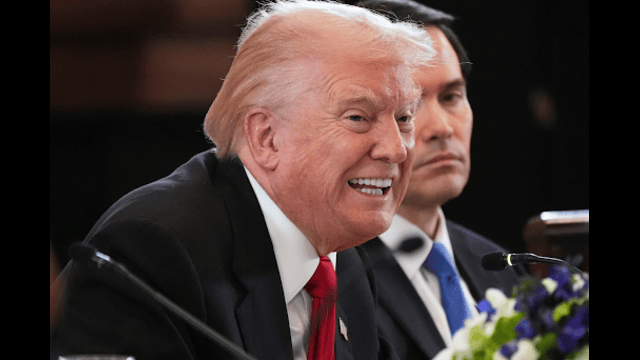
President Donald Trump attends a dinner with leaders from countries in Central Asia, Thursday, Nov. 6, 2025, in the East Room of the White House in Washington.
President Donald Trump welcomed leaders from five Central Asian nations — Kazakhstan, Kyrgyzstan, Tajikistan, Turkmenistan, and Uzbekistan — to the White House on Thursday. The meeting aimed to deepen U.S. partnerships in the region and secure rare earth metals vital for high-tech manufacturing.
The Oval Office talks and a subsequent working dinner highlighted Trump’s push to reduce America’s dependence on China for rare earth minerals used in smartphones, electric vehicles, and fighter jets.
“These nations were once home to the great Silk Road,” Trump said, adding that the region had been “sadly neglected” by previous administrations.
The summit came shortly after a temporary easing of trade tensions with China, following discussions between Trump and Chinese leader Xi Jinping over rare earth exports.
Central Asia’s Critical Mineral Wealth
Central Asia is rich in critical minerals and holds nearly half the world’s uranium reserves — essential for nuclear energy. However, the region lacks the investment and infrastructure needed to fully develop these resources.
For decades, Central Asian mineral exports have leaned heavily toward China and Russia. Kazakhstan alone exported over $3 billion worth of critical minerals to China in 2023, while shipments to the U.S. totaled only $544 million, according to trade data from the Observatory of Economic Complexity.
Trump emphasized that his administration was working to diversify supply chains. “We’re strengthening American economic security by forging new agreements with our allies,” he said.
The visiting leaders praised the move, viewing it as a chance to attract U.S. investment and balance relations with neighboring powers.
Strategic Importance Amid China-Russia Rivalry
Tajikistan’s President Emomali Rahmon described his country’s mineral resources as “very rich and boundless.” He stressed that closer ties with Washington were crucial, especially given Tajikistan’s strategic position between Russia and China.
“We are keen to deepen cooperation on security issues,” Rahmon said.
The meeting also came a day after U.S. senators proposed legislation to remove outdated Soviet-era trade restrictions. Lawmakers said the move would help boost American investment in the newly independent Central Asian republics.
Senator Jim Risch, chairman of the Senate Foreign Relations Committee, stated, “The United States offers Central Asia a genuine partnership while helping each other’s economies grow.”
Strengthening the C5+1 Partnership
The five nations, known collectively as the “C5+1,” have long collaborated with the U.S. on regional stability and counterterrorism. The latest summit, marking the group’s 10th anniversary, shifted focus toward economic growth and technology cooperation.
Secretary of State Marco Rubio hosted the leaders at the State Department on Wednesday, calling the partnership “an exciting new opportunity where our national interests align.”
Deputy Secretary Christopher Landau and U.S. envoy Sergio Gor recently visited Kazakhstan and Uzbekistan to prepare for the summit. Gor assured the delegations that the region now had “a direct line to the White House.”
Kazakhstan Joins Abraham Accords
In a surprise announcement, Kazakhstan agreed to join the Abraham Accords, Trump’s signature Middle East peace initiative. The decision reinforced the White House’s goal of expanding the accords beyond the Middle East.
Kazakhstan, a Muslim-majority nation that has maintained ties with Israel since 1992, became the latest country to endorse the initiative.
Trump said he hoped more nations, including Saudi Arabia and Indonesia, would soon join. Both countries have said they would not normalize relations with Israel until a path toward a Palestinian state is established.
The president also downplayed concerns over the Gaza ceasefire, calling it “a very strong peace.”
A New Chapter in U.S.–Central Asia Relations
Trump’s outreach marks a turning point in U.S. engagement with Central Asia — a region long influenced by Moscow and Beijing. By offering investment and diplomatic attention, Washington aims to position itself as a credible alternative partner.
As global competition for rare earth minerals intensifies, the White House hopes these new partnerships will secure America’s technological edge while helping Central Asia achieve greater independence from regional giants.