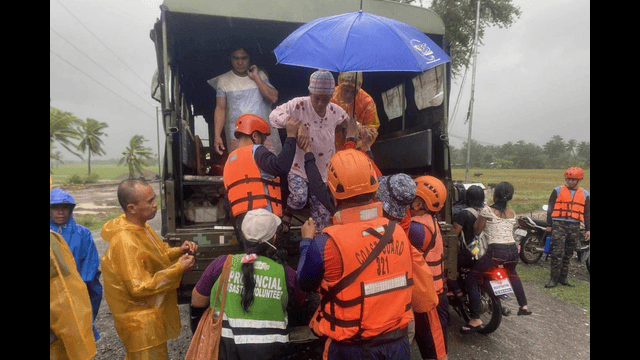
In this photo provided by the Philippine Coast Guard, rescuers evacuate residents in Sablayan, Occidental Mindoro province of the Philippines as Typhoon Fung-wong batters the country on Sunday, Nov. 9 2025.
Typhoon Fung-wong exited the northwestern Philippines on Monday, leaving behind a trail of floods, landslides, and destruction. The powerful storm claimed at least two lives and displaced over 1.4 million residents before heading toward Taiwan.
Twin Disasters Hit the Philippines
Fung-wong struck while the nation was still reeling from Typhoon Kalmaegi, which had already killed more than 224 people in central regions. The overlapping storms intensified the country’s ongoing struggle with flooding, power outages, and displacement.
Kalmaegi also battered Vietnam last week, killing at least five people there, compounding the regional crisis in Southeast Asia.
Super Typhoon’s Ferocious Landfall
Fung-wong made landfall in Aurora province on Sunday night as a super typhoon, packing sustained winds of up to 185 kph (115 mph) and gusts reaching 230 kph (143 mph).
The 1,800-kilometer-wide storm swept across the mountainous north, tearing through agricultural plains and remote communities. By Monday morning, it had weakened slightly and drifted out toward the South China Sea, according to state forecasters.
Widespread Floods and Damage
Officials reported massive flooding across 132 villages in northern provinces. In some areas, residents were forced onto their rooftops as water levels rose rapidly overnight.
One person drowned in Catanduanes province, while another woman died in Catbalogan City, Eastern Samar, after her house collapsed during the storm.
At least 1,000 homes were damaged, and several roads were blocked by landslides. Authorities said clearing operations would continue as weather conditions improved.
Government Response and State of Emergency
Philippine President Ferdinand Marcos Jr. declared a state of emergency last Thursday, anticipating the combined impact of Kalmaegi and Fung-wong.
“The typhoon may have passed, but its rains still pose a danger,” warned Bernardo Rafaelito Alejandro IV of the Office of Civil Defense. He confirmed that rescue and relief operations were ongoing in northern Luzon and Metro Manila.
Despite the scale of destruction, the government has not yet requested international aid. However, allies like the United States and Japan have offered assistance if needed, said Defense Secretary Teodoro.
Disruptions Across the Country
The storm’s fury caused nationwide disruptions. Schools and government offices were closed on Monday and Tuesday. More than 325 domestic and 61 international flights were canceled, stranding thousands of passengers.
Rough seas forced the coast guard to halt maritime travel, leaving over 6,600 commuters and cargo workers stranded in ports. Entire provinces also suffered widespread power outages, adding to the chaos in affected communities.
A Nation Prone to Disasters
The Philippines faces around 20 typhoons and storms every year, making it one of the world’s most disaster-prone countries. Apart from frequent cyclones, it also experiences earthquakes and volcanic eruptions due to its location along the Pacific “Ring of Fire.”
Meteorologists classify any tropical cyclone with sustained winds exceeding 185 kph as a super typhoon, emphasizing the increasing intensity of storms linked to climate change.
Moving Forward After Typhoon Fung-wong
As skies begin to clear, recovery efforts are ramping up across northern Luzon. Officials continue to monitor possible aftereffects, including flash floods and landslides.
With two major storms striking in quick succession, the country’s disaster-response capabilities are being tested once again. For millions of Filipinos displaced or affected, the focus now shifts to rebuilding homes, restoring power, and regaining stability after Typhoon Fung-wong’s devastating blow.