

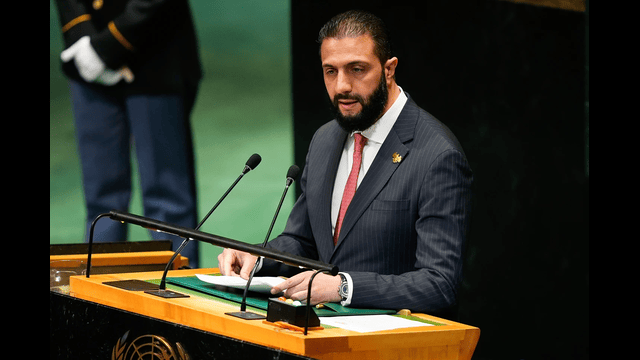
Syrian President Ahmad Al-Sharaa speaks during the 80th session of the United Nations General Assembly, Sept. 24, 2025, at U.N. headquarters.
Ahmad al-Sharaa, once detained by U.S. forces in Iraq two decades ago, has emerged as a symbol of political transformation. Today, he stands poised to become the first Syrian president to visit the White House since the country’s independence in 1946.
The visit comes less than a year after al-Sharaa’s rebel forces toppled former President Bashar al-Assad, ending 14 years of civil war. His rise — from a former militant to a global statesman — marks a turning point in Syria’s tumultuous history.
From Rebel Commander to Statesman
Al-Sharaa’s journey is nothing short of extraordinary. Once aligned with al-Qaida militants in Iraq, he later severed ties with extremist networks and built a broad-based coalition to challenge Assad’s regime.
Since assuming power, al-Sharaa has launched a diplomatic charm offensive, rebuilding relationships with countries that had long isolated Syria. His government’s outreach is aimed at stabilizing Syria’s shattered economy and restoring international trust.
First White House Visit in Nearly Eight Decades
After meeting former U.S. President Donald Trump in Saudi Arabia in May, al-Sharaa now travels to Washington for a historic summit. The two leaders are expected to finalize Syria’s entry into the U.S.-led coalition against the Islamic State (IS).
Syrian state media confirmed that al-Sharaa arrived in the U.S. on Saturday. The upcoming discussions are expected to focus on security cooperation, economic recovery, and the future of sanctions.
Push to Lift Sanctions and Revive the Economy
A major goal of al-Sharaa’s visit is to secure a full repeal of the Caesar Act, which imposed sanctions over Assad-era human rights abuses. While the sanctions have been temporarily waived by presidential order, permanent repeal requires congressional approval.
Syria’s Ministry of Information said the president would highlight the importance of lifting economic sanctions to encourage foreign investment and growth. He will also reaffirm Syria’s commitment to counterterrorism and regional security.
Trump recently expressed optimism about Syria’s direction, saying, “It’s a tough neighborhood, and he’s a tough guy. But I got along with him very well.”
Global and Political Reactions
Last week, the U.N. Security Council voted to lift sanctions on al-Sharaa and his interior minister. The U.S. followed by removing their names from its “global terrorist” list.
However, debate over the Caesar Act continues in Washington. Some Republicans, including Rep. Brian Mast and Sen. Lindsey Graham, support a conditional repeal that would require Syria to protect minority groups, maintain peaceful ties with neighbors like Israel, and remove foreign fighters from its military institutions.
Advocacy groups, including Save the Persecuted Christians, have urged the U.S. to address the sectarian violence that flared over the past year, demanding protection for Alawite and Druze minorities.
Meanwhile, Sen. Jeanne Shaheen, a leading Democrat, argues that lifting sanctions could unlock a new era of cooperation. “We have a real opportunity in the Middle East right now that we haven’t had in my lifetime,” she said.
Building a Stronger Anti-IS Coalition
Washington officials say Syria’s formal entry into the anti-IS coalition will mark a “milestone” in counterterrorism cooperation. Although Syrian troops have long fought IS independently, the agreement could pave the way for joint operations with U.S. forces.
According to U.S. Central Command, IS attacks in Syria have dropped significantly—from 878 in 2024 to just 311 this year—indicating progress in the fight against extremism.
Before taking office, al-Sharaa—known by his former nom de guerre Abu Mohammed al-Golani—led Hayat Tahrir al-Sham (HTS), an insurgent group that once controlled parts of northwestern Syria. Though once linked to al-Qaida, HTS split from the group and later battled IS fighters in its territories.
A New Strategic Partnership
Since al-Sharaa’s rise to power, the U.S. has expanded its coordination with Damascus, including efforts to merge the Syrian Democratic Forces (SDF) with the new Syrian army.
While the two groups have agreed in principle, tensions persist, occasionally erupting into clashes. Still, officials on both sides remain optimistic that closer cooperation could strengthen regional stability.
As al-Sharaa steps into the White House, his visit represents more than a diplomatic milestone — it signals Syria’s re-emergence on the global stage and a potential end to years of isolation.













