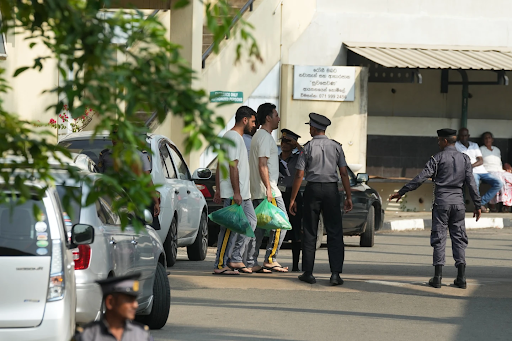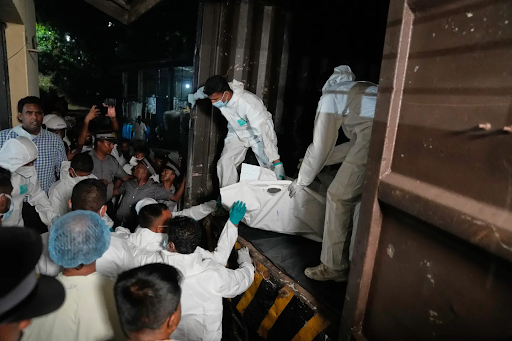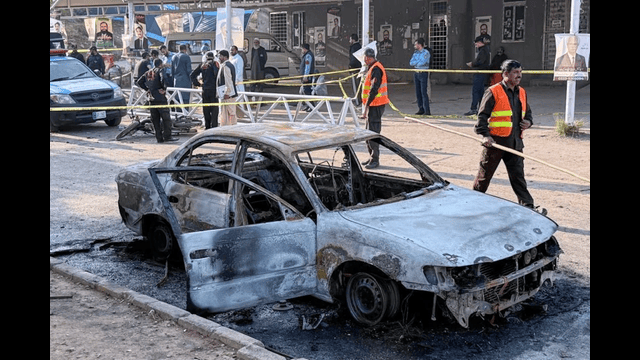
Security officials and rescue workers gather at the site following a suicide bombing outside the gates of a district court, in Islamabad, Pakistan, Tuesday, Nov. 11, 2025.
A deadly suicide bombing in Islamabad on Tuesday has left 12 people dead and at least 27 injured, marking another surge in militant attacks across Pakistan. The explosion struck outside a busy district court, spreading panic in the capital and deepening fears over the country’s worsening security situation.
Chaos Outside Islamabad Court
The attacker detonated explosives beside a police vehicle after failing to enter the court complex, according to Interior Minister Mohsin Naqvi. The blast occurred during peak court hours, when the area was packed with lawyers, civilians, and court visitors.
Witnesses described scenes of horror and confusion. “People started running in all directions,” said Mohammad Afzal, a witness present at the scene. Ambulances rushed to rescue the wounded as smoke and debris filled the area.
Authorities confirmed that most of the victims were civilians waiting for hearings. Police later found a severed head believed to be the bomber’s, confirming the attack was suicide-based.
Militant Group Claims — and Denies — Responsibility
The Jamaat-ul-Ahrar faction, a splinter group of the Pakistani Taliban (TTP), initially claimed responsibility for the bombing through messages sent by its leader Omar Mukkaram Khurasani. However, confusion deepened when another commander from the same group, Sarbakaf Mohmand, denied any involvement.
Jamaat-ul-Ahrar split from the TTP in 2022 after its leader was killed in Afghanistan. While some members have since rejoined the TTP, others remain independent, revealing deep divisions among Pakistan’s insurgent networks.
The TTP, separate but allied with the Afghan Taliban, has increased attacks inside Pakistan since the Taliban seized control of Kabul in 2021.
Pakistan Blames “Foreign-Backed Elements”
Without providing evidence, Interior Minister Naqvi accused Indian-backed elements and Afghan Taliban proxies of orchestrating the bombing through TTP-linked operatives.
India swiftly rejected the claim. “The international community will not be misled by Pakistan’s diversionary tactics,” said Indian Foreign Ministry spokesperson Randhir Jaswal.
Despite the tension, Naqvi insisted that investigators are examining “all angles” of the attack, including domestic terror networks.
Global Condemnation and Calls for Justice
The attack drew international condemnation. The United States, China, Saudi Arabia, Qatar, and Turkey denounced the violence and offered condolences.
UN Secretary-General António Guterres urged Pakistan to conduct a thorough investigation and ensure that “all perpetrators of terrorism are held accountable,” according to UN spokesman Farhan Haq.
Another Attack Targets Military College
The bombing followed a foiled militant assault on an army-run cadet college in Wana, a city near the Afghan border.
Armed attackers, including a suicide car bomber, tried to storm the facility and hold cadets hostage. Security forces responded swiftly, killing two militants outside the compound and trapping three others inside an administrative block.
Officials said no cadets or staff were harmed, as commandos evacuated hundreds of students to safety. The TTP denied involvement in both the Wana assault and the Islamabad bombing.
Government Vows Accountability
Prime Minister Shehbaz Sharif condemned the twin attacks as “reprehensible” and vowed to bring the culprits to justice. “We will ensure those responsible are apprehended and held accountable,” he said in a statement.
Defense Minister Khawaja Asif blamed the Taliban government in Afghanistan, accusing it of sheltering TTP fighters. “Bringing this war to Islamabad is a message from Kabul,” Asif warned, adding that Pakistan “has the strength to respond fully.”
Rising Militant Threat and Regional Strain
Militant attacks have sharply increased in Pakistan over the past few years. The TTP, banned in Pakistan and listed as a terrorist organization by the United States and the United Nations, has exploited tensions along the Afghan border.
The last major school attack in 2014, carried out by a TTP splinter group, killed 154 people—mostly children—in Peshawar. Authorities fear the Wana attack was an attempt to replicate that tragedy.
Meanwhile, peace talks between Islamabad and Kabul remain stalled. Two recent rounds in Istanbul failed after Afghanistan refused to provide written assurances that its soil wouldn’t be used by militants against Pakistan.
As Pakistan mourns yet another tragedy, the Islamabad suicide bombing underscores the fragile security landscape and the growing challenge of combating militancy amid regional mistrust.