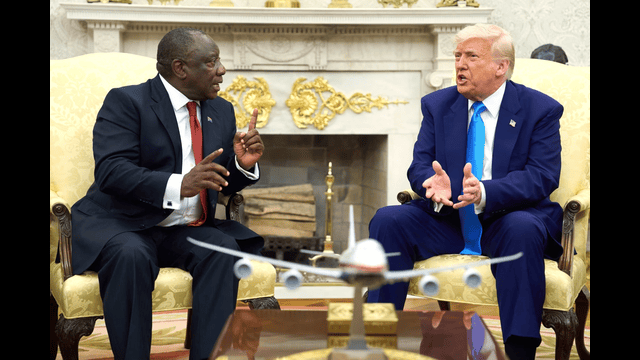
President Donald Trump meets South Africa’s President Cyril Ramaphosa in the Oval Office of the White House, May 21, 2025, in Washington.
South African President Cyril Ramaphosa has criticized U.S. President Donald Trump’s decision to boycott the upcoming G20 Summit in Johannesburg, calling it “their loss.” Ramaphosa said the move undermines America’s global leadership role and shows the failure of “boycott politics.”
The G20 Summit, scheduled for November 22–23, marks the first time the global economic forum will be hosted in Africa. Leaders from 19 major economies and the European Union are expected to attend — except the United States.
Trump’s Controversial Boycott
Trump announced the boycott last week on Truth Social, declaring that no U.S. government representative would attend the summit. His decision was based on unfounded claims that white farmers, known as Afrikaners, are being persecuted and having their land seized in South Africa.
The U.S. president wrote that it was “a total disgrace that the G20 will be held in South Africa,” accusing the country’s government of “racism against whites.” His remarks echoed long-standing narratives from far-right commentators in the U.S. that have circulated since 2018.
Ramaphosa Responds: “We Move Forward Without Them”
Speaking outside Parliament on Wednesday, Ramaphosa expressed disappointment but insisted that the summit would proceed as planned.
“It is unfortunate that the United States decided not to attend the G20,” he said. “All other world leaders will be here, and we will take fundamental decisions. Their absence is their loss.”
Ramaphosa emphasized that the U.S., as the world’s largest economy, is forfeiting an important opportunity to influence global discussions on economic growth and development.
He also criticized Washington’s decision to disengage, saying: “The United States needs to rethink whether boycott politics actually works. In my experience, it doesn’t.”
Strained U.S.–South Africa Relations
Relations between the two nations have hit their lowest point since the end of apartheid in 1994. Tensions escalated earlier this year when Washington expelled South Africa’s ambassador after he made remarks critical of Trump.
Trump’s ongoing criticism of South Africa’s Black-led government — particularly over its affirmative action policies and its legal challenge against Israel at the United Nations’ top court — has further strained ties.
His accusations of “anti-white” racism have been dismissed by South African officials as misinformation. The government maintains that affirmative action aims to redress historic injustices from the apartheid era, not to discriminate against any group.
Missed Opportunity for U.S. Global Leadership
Ramaphosa noted that the G20 Summit in Johannesburg represents a historic moment for Africa. It brings together developed and emerging economies to address challenges such as climate change, global inequality, and sustainable development.
“The G20 will go on,” Ramaphosa said confidently. “We are ready to lead important discussions that shape the global economy, with or without the United States.”
The United States was originally expected to be represented by Vice President JD Vance after Trump confirmed he would not attend personally. However, following the boycott order, the U.S. will have no official presence at the meeting.
Political Context Behind the Boycott
Trump’s statements have reignited debate about race relations and misinformation in international politics. His claims about violence against South Africa’s white minority have been repeatedly debunked by independent studies and human rights organizations.
Observers say the boycott reflects Trump’s broader pattern of withdrawal from global cooperation and his tendency to use international issues for domestic political appeal.
G20 to Continue Without U.S. Participation
Despite the absence of the United States, South Africa says the G20 Summit will proceed successfully, with leaders from China, India, Russia, Japan, France, Germany, the U.K., and the European Union confirming attendance.
South Africa will hand over the rotating G20 presidency to the U.S. later this year — an irony not lost on observers following Trump’s withdrawal decision.
For now, Ramaphosa remains firm: “The world will continue to engage. The G20 will continue to lead. And the U.S. will realize that stepping away means stepping back from the global stage.”