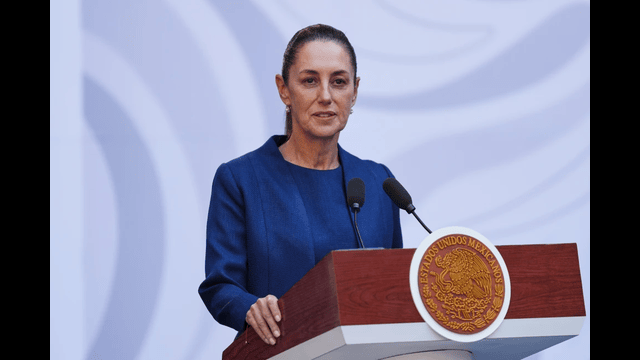
Mexican President Claudia Sheinbaum presents a new security strategy against violence for the Michoacan state, at the National Palace, in Mexico City, Sunday, Nov. 9, 2025.
Mexico firmly rejected the idea of U.S. military strikes on its soil after former U.S. President Donald Trump suggested using force to combat drug cartels. President Claudia Sheinbaum reiterated that Mexico will never allow foreign intervention, emphasizing national sovereignty and diplomatic cooperation instead.
Mexico Stands Firm Against Foreign Military Action
Sheinbaum made her position clear on Tuesday. She said Trump has repeatedly offered U.S. military intervention to fight criminal groups in Mexico.
Her response remained unwavering.
“It’s not going to happen,” she said.
Sheinbaum explained that cooperation is welcome, but only within limits.
The U.S. can share intelligence, she noted, but Mexico alone operates on Mexican territory. She also said she communicated this stance to both Trump and U.S. Secretary of State Marco Rubio, and that they understood her position.
Trump Pushes a Hardline Approach
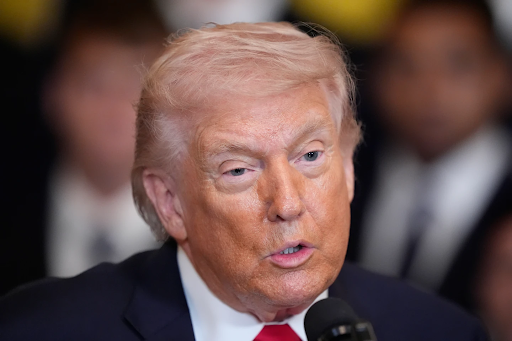
Trump reiterated his stance on Monday.
“Would I want strikes in Mexico to stop drugs? OK with me,” he said. He added that he was “not happy with Mexico.”
His remarks triggered diplomatic discussions as the two countries navigated a tense moment involving a potential border misunderstanding.
Confusion Over Possible U.S. Incursion
Concerns escalated on Monday after men arrived by boat at Playa Bagdad in northeast Mexico and posted signs labeling the area as restricted U.S. Department of Defense property.
The signs were written in English and Spanish.
They warned the public not to enter, photograph, or draw the area, citing orders from “the commander.”
Mexico’s Navy quickly removed the signs after confirming they stood on the Mexican side of the border.
By Tuesday, Sheinbaum said the International Boundary and Water Commission (IBWC) was involved to help determine the exact border position, since the Rio Grande frequently shifts its course.
Pentagon Confirms Sign Installation Was an Error
The U.S. Embassy in Mexico shared a Pentagon statement clarifying the incident.
It said U.S. contractors had placed the signs to mark “National Defense Area III.”
But due to changes in water levels and shifting topography, the contractors misjudged the location of the international boundary.
Mexico removed six signs, believing they were placed within Mexican territory.
The Pentagon acknowledged the confusion and promised better coordination with Mexican authorities in the future.
Sensitive Zone Near SpaceX Starbase
The incident occurred near the SpaceX Starbase facility in Texas, close to the mouth of the Rio Grande.
The area is heavily monitored because SpaceX operates under contracts with both the Department of Defense and NASA.
In June, Sheinbaum’s government began investigating environmental concerns after debris from a SpaceX rocket test reportedly fell on the Mexican side of the border.
This region is also politically sensitive because Trump once proposed renaming the Gulf of Mexico as the Gulf of America, a move Mexico strongly rejected.
Diplomacy Over Force
Despite Trump’s aggressive rhetoric, Sheinbaum stressed that Mexico remains committed to cooperation — but only within the framework of sovereignty and mutual respect.
“We do not accept any intervention by a foreign government,” she said.
As both nations manage cross-border challenges — from cartel violence to environmental concerns — Mexico’s stance is clear: partnership is welcome, but military intervention is not.