

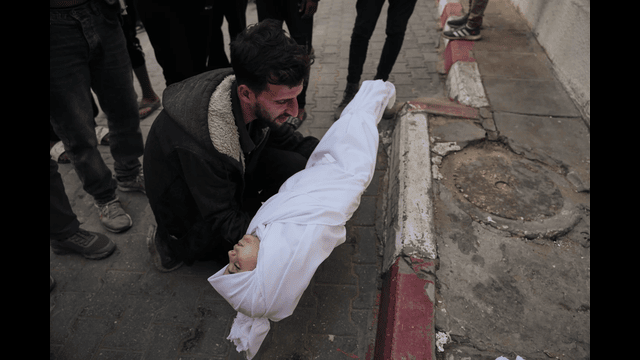
A man carries the body of a child from the Azzam family, killed in Israeli strikes, during her funeral at Shifa Hospital in Gaza City, Thursday, Nov. 20, 2025.
Israeli airstrikes on Gaza killed 33 people within 12 hours, marking one of the deadliest escalations since the Oct. 10 ceasefire began. Most victims were women and children, according to hospital officials in Khan Younis and Gaza City.
Deadly Night in Khan Younis
Gaza’s southern city, Khan Younis, was hit hardest. Israeli strikes early Thursday killed five people, adding to the growing toll from four attacks on tents sheltering displaced families.
Officials at Nasser Hospital confirmed that 17 people, including five women and five children, died in these tent strikes. Many victims had fled earlier fighting and were living in makeshift shelters.
Israel said the strikes were a response to shots fired at its soldiers in Khan Younis on Wednesday. The military reported no casualties among its troops.
Children Among the Dead in Gaza City
In Gaza City, two Israeli airstrikes on a residential building killed 16 people. The dead included seven children and three women, according to the Al-Shifa Hospital staff. Bodies were brought in from across the city’s devastated neighborhoods.
Hamas called the attacks a “shocking massacre” and denied firing on Israeli troops, accusing Israel of violating the ceasefire agreement.
Families Grieve Amid Rubble
At Nasser Hospital, grief filled the courtyard as families gathered for quick funeral prayers. White burial shrouds covered rows of bodies—many belonging to children.
One mother, Abir Abu Moustapha, lost her husband and three children when their tent was hit Wednesday.
“My children are gone… What was their fault?” she cried beside the bodies of her children, aged 1, 11, and 12.
Her story reflects the deep human cost of the renewed violence, especially for families trapped between shifting front lines.
Israeli Military Claims Targeted Operations
The Israeli military said the latest strikes aimed to kill two Hamas operatives—one linked to the group’s naval unit, and another overseeing tunnel networks in Khan Younis.
Hospital officials noted that victims came from both sides of the ceasefire boundary, which divides Gaza in half and places roughly half the territory under Israeli military control.
Ceasefire Under Strain After UN Approval
The escalation followed the UN Security Council’s endorsement of a plan backed by U.S. President Donald Trump to stabilize post-conflict Gaza.
The proposal includes:
- An international security force
- A transitional governing authority
- A potential path toward a future Palestinian state
But Hamas rejected the plan, arguing that its provisions—especially disarmament—eliminate neutrality and “turn the force into a party to the conflict.”
Airstrikes Reduced but Still Ongoing
Despite the ceasefire, Israeli strikes have continued sporadically. Gaza’s Health Ministry reported over 300 deaths since the truce began in October.
Terms of the ceasefire include increased aid flow to Gaza and the return of hostages. Each side blames the other for violating these commitments.
Israel’s ongoing Gaza campaign, launched in response to Hamas’ Oct. 7, 2023 attack, has killed more than 69,000 Palestinians, according to Gaza’s Health Ministry—figures widely regarded as reliable by the UN.
During the ceasefire, Hamas released the last 20 living Israeli hostages in exchange for hundreds of Palestinian prisoners. It has also returned the remains of 25 deceased hostages and is expected to return three more.
Hostages Speak of Abuse
As hostages return home, disturbing accounts of abuse are surfacing.
Israeli hostage Guy Gilboa-Dalal told Channel 12 News he was sexually abused in captivity. He described being threatened at gunpoint and warned not to reveal the assault.
Another male hostage, Rom Braslavski, reported similar abuse.
Meanwhile, Palestinians released from Israeli prisons say they endured beatings, sexual abuse, extreme deprivation, and medical neglect. Some detainees developed infections that later required amputation.
A Ceasefire Tested by Tragedy
The rising death toll in Gaza—now 33 in just 12 hours—has intensified questions about the durability of the ceasefire and the path ahead for a shattered territory.
As families bury loved ones, both sides face mounting pressure to uphold the fragile truce. The latest strikes underscore how quickly the situation in Gaza can unravel, even under a ceasefire meant to offer relief.













