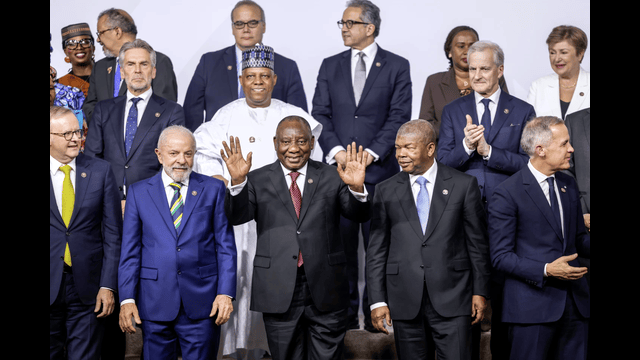
From left, front row, Australia’s Prime Minister Anthony Albanese, Brazil’s President Luiz Inacio Lula da Silva, South Africa’s President Cyril Ramaphosa, President of Angola and Chairperson of the African Union Joao Lourenco and Canada’s Prime Minister Mark Carney react as they pose a group photo, on the opening day of the G20 Leaders’ Summit, in Johannesburg, South Africa, Saturday, Nov. 22, 2025.
The G20 summit in South Africa concluded on Sunday under an unusual cloud — the complete absence of the United States, which is set to assume the next G20 presidency. The boycott by the Trump administration dominated conversations, overshadowing many of the summit’s intended priorities.
A Summit Closed Without the U.S.
South African President Cyril Ramaphosa officially ended the summit in Johannesburg by striking a wooden gavel, a long-standing G20 tradition. Normally, the gavel is passed to the next country holding the rotating presidency. But this year, no U.S. representative was present to receive it.
The U.S. boycott stemmed from President Donald Trump’s accusations that South Africa is violently targeting its Afrikaner white minority — a claim that South African officials have firmly rejected.
Despite a last-minute attempt by Washington to send a lower-level embassy official, South Africa refused, calling the proposal inappropriate for a formal handover. With no agreement reached, the U.S. delegation remained unaccredited, forcing South Africa to postpone the ceremonial transfer.
A Break from Tradition as Tensions Rise
This year’s summit also departed from protocol, issuing its leaders’ declaration on the first day instead of the last. The early release highlighted mounting tensions within the bloc, especially U.S. opposition to South Africa’s G20 agenda.
The declaration focused on issues affecting developing nations — from climate-related disaster recovery to debt relief and green-energy support. Most major economies, including the U.K., China, Russia, France, Germany, Japan and Canada, backed the document.
However, the U.S. and Argentina rejected the declaration. Argentina’s libertarian President Javier Milei, a Trump ally, also skipped the summit.
Ramaphosa emphasized Africa’s central role, saying the presidency helped place “Global South priorities at the heart of the G20 agenda.” After the closing session, leaders congratulated him, and an unintentional hot-mic moment captured him admitting, “It was not easy.”
G20’s Global Struggles Come into Focus
South Africa celebrated the adoption of the Johannesburg Declaration as a diplomatic win. Yet experts questioned the long-term influence of the document, noting that G20 declarations remain non-binding and often symbolic.
Some of South Africa’s more ambitious ideas — like forming a new global panel on wealth inequality, mirroring the UN’s climate science body — did not make the final text.
The G20, created in 1999 after the Asian financial crisis, is under pressure to demonstrate relevance during major global conflicts. The declaration’s single reference to the Ukraine war appeared in a general appeal for peace, underscoring the bloc’s limited impact despite having Russia, the EU, and major European powers in one room.
French President Emmanuel Macron praised the significance of hosting the first G20 summit in Africa but admitted the grouping is “struggling to have a common standard on geopolitical crises.”
Symbolism and Global Inequality Take Center Stage
Despite the political tension, many observers saw the summit as a milestone for poorer nations.
Oxfam’s Max Lawson called it historic, saying it was the first global leaders’ meeting to place inequality at the center of its agenda.
Namibia’s President Netumbo Nandi-Ndaitwah echoed the sentiment, stressing the importance of incorporating African development priorities into global economic conversations. More than 20 smaller nations were invited as guests, broadening the summit’s inclusive message.
Looking Ahead to a Controversial U.S. Presidency
South Africa said the formal G20 handover to the U.S. will happen later, likely through diplomatic channels. President Trump has already announced that next year’s summit will be held at his Doral golf club in Florida, a decision that has attracted scrutiny.
As the summit closed, one message became clear: the G20 faces mounting internal fractures. With growing geopolitical divides, climate pressures, and debates over economic inequality, the path ahead — under a U.S. presidency — remains uncertain.