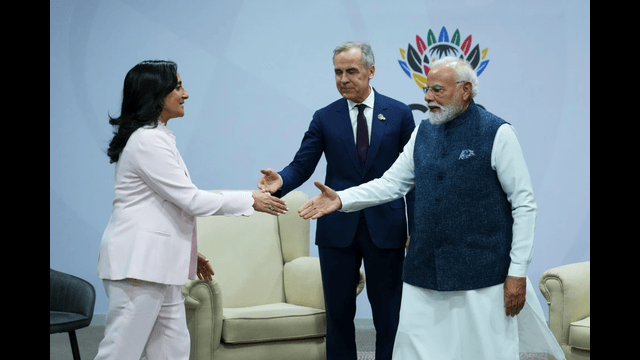
Canada’s Prime Minister Mark Carney, middle, introduces Minister of Foreign Affairs Anita Anand, left, during a bilateral meeting with Indian Prime Minister Narendra Modi during the G20 Summit, in Johannesburg, Sunday, Nov. 23, 2025.
Canada has signaled a rapid push to revive a long-delayed India trade deal, marking a major shift in its global economic strategy. Foreign Minister Anita Anand confirmed on Monday that Ottawa is moving “as quickly as possible” to restart negotiations after two years of tense relations with New Delhi.
The renewed momentum follows a high-level meeting between Prime Minister Mark Carney and Indian Prime Minister Narendra Modi at the G20 Summit in South Africa. Both leaders agreed that advancing the India trade deal is now a priority for their governments.
A Reset After Strained Canada–India Relations
Diplomatic ties between the two countries deteriorated sharply in 2023. At the time, Canada publicly accused India of involvement in the killing of Sikh activist Hardeep Singh Nijjar in British Columbia. The allegation triggered a diplomatic freeze and halted trade discussions.
Nijjar, a 45-year-old Canadian citizen originally from India, was fatally shot outside a Sikh temple in Surrey. Four Indian nationals living in Canada have since been charged with the murder and are currently awaiting trial.
Despite the controversy, relations began improving earlier this year. Carney invited Modi to the G7 Summit in Alberta, and both countries reinstated their top-level diplomats in August. These developments opened the door for discussions on the India trade deal to resume.
Canada Prioritizes India Trade Deal Amid Global Shifts
According to Anand, the renewed push aligns with Canada’s new foreign policy direction, shaped by rapidly changing global economic pressures. She highlighted growing protectionism worldwide, including in the United States, Canada’s biggest trading partner.
More than 75% of Canadian exports currently go to the U.S., most of which are exempt under the USMCA agreement. However, with the trade pact up for review in 2026, Ottawa is looking to diversify aggressively.
“This is a completely new approach to foreign policy,” Anand said. “There is a new government, a new prime minister, and a new world order.”
Carney aims to double Canada’s non-U.S. trade over the next decade, making the India trade deal a cornerstone of that strategy. He is expected to visit India early next year to accelerate discussions.
Aiming for Stronger Canada–India Economic Ties
India currently ranks as Canada’s seventh-largest trade partner for goods and services. Canadian investments also play a significant role in India’s technology, infrastructure, and financial sectors.
Anand stated that both nations expect to double bilateral trade to US$50 billion by 2030. “This is a step-by-step process,” she said, “but the last six months have delivered significant progress.”
The India trade deal is also seen as essential for tapping into India’s growing economic influence and rapidly expanding consumer market.
Canada Also Looks to Rebuild China Ties
While pursuing the India trade deal, Canada is also attempting to stabilize relations with China. Carney and Chinese President Xi Jinping met recently at the Asia-Pacific summit, taking a symbolic step toward repairing years of diplomatic tension.
Ottawa’s broader strategy aims to reduce reliance on U.S. markets while strengthening ties across Asia.
Navigating Tensions with the United States
Despite diversification efforts, Canada still seeks stable trade relations with Washington. However, tensions resurfaced in the past during trade talks involving former U.S. President Donald Trump.
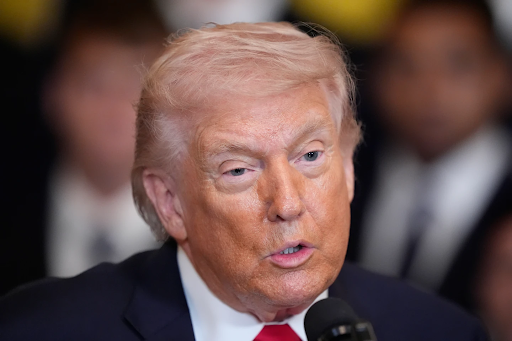
Trump previously cut off negotiations after an anti-tariff advertisement in the U.S. angered him. The dispute followed months of friction over Trump’s suggestion that Canada should become the “51st U.S. state.”
Even so, Anand stressed that Ottawa remains open to resuming trade discussions with Trump, stating: “The United States has fundamentally changed its trading relationships, and we look forward to getting back to the table.”
Moving Forward with the India Trade Deal
With a new foreign policy and shifting global alliances, Canada appears determined to finalize the India trade deal as soon as possible. Both governments believe the deal would expand economic opportunities, reduce reliance on the U.S., and strengthen ties between two major democracies.
As Carney prepares for his India visit next year, the long-stalled trade negotiations are finally gaining renewed momentum—signaling a fresh chapter in Canada–India relations.