

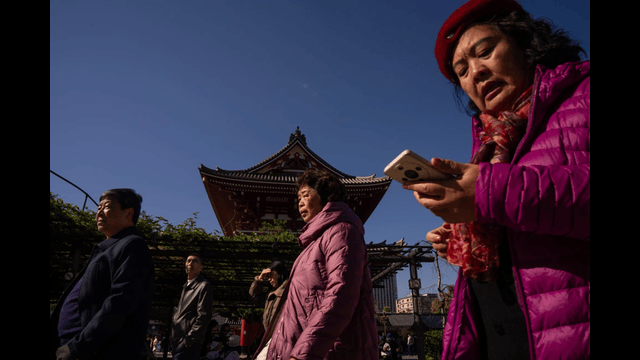
Mainland Chinese tourists visit Sensoji temple in the Asakusa district of Tokyo, Thursday, Nov. 20, 2025.
China’s latest pressure campaign against Japan is beginning to ripple across key sectors, from tourism to entertainment and trade. The friction follows Japan’s refusal to withdraw a statement by new Prime Minister Sanae Takaichi, who suggested Tokyo could intervene if China were to act against Taiwan — a position Beijing considers a direct challenge to its core interests.
Travel Advisory Sparks Immediate Cancellations
The impact of China’s travel advisory surfaced quickly. In Tokyo’s historic Asakusa district, tea ceremony instructor Rie Takeda saw more than 200 Chinese tourists cancel bookings — some for dates as far ahead as January.
She hopes that tourists return by Chinese New Year in February, but past tensions suggest a longer recovery.
Group tours, often the backbone of inbound tourism, are again being canceled. Gamagori Hotel in central Japan lost over 2,000 guests, while tour company Nichu Syomu faced 300 cancellations — a setback reminiscent of the 2012 travel freeze.
Economist Takahide Kiuchi warns the advisory could slash Japan’s economic growth and cost the country 1.8 trillion yen ($11.5 billion) this year.
Beijing Uses an Old Tactic of Economic Pressure
China’s reaction mirrors tactics used previously against Australia, South Korea, and the Philippines: apply economic pain while openly criticizing the targeted government.
According to Tsinghua University professor Liu Jiangyong, China’s “countermeasures” will continue and may intensify, as the dispute strikes at “the core of the nation’s core interests.”
Japan, however, has shown no sign of backing down. Analysts note that both nations face domestic audiences, making compromise less likely. These standoffs often last a year or more, ending only when political leadership shifts — as seen in Australia and Canada.
Tensions Over Taiwan Spark the Dispute
The core flashpoint is Taiwan. Prime Minister Takaichi’s statement that Japan’s military might intervene in a Taiwan conflict drew immediate condemnation from Beijing.
The issue now fuels protests in Tokyo and has become a political test for both governments. Neither side wants to appear weak.
Japan is attempting to prevent further escalation, but officials privately acknowledge that tensions may linger until a diplomatic opening emerges.
China’s Tourism and Cultural Restrictions Expand
China had been on track to reclaim its position as Japan’s largest tourist source this year, with more than 8 million Chinese travelers visiting in the first 10 months. Now, tourism recovery is grinding to a halt.
Individual travelers also face pressure. Some Chinese citizens report receiving workplace instructions advising them not to visit Japan. Others remain undecided.
Meanwhile, a Chinese-owned ski lodge in Hokkaido saw two cancellations — but replacements came quickly, showing the mixed private response.
Cultural and Commercial Fallout Deepens
Beyond tourism, Chinese authorities have paused several Japan-linked cultural releases. Two films — Cells at Work! and Crayon Shin-chan: Super Hot! — had their Chinese premieres abruptly postponed.
A comedy festival in Shanghai canceled performances by a Japanese company. Publishing projects involving Japanese works have also been suspended.
These actions signal that China may widen its economic and soft-power pressure campaign.
Seafood, Rare Earths, and Future Measures
Confusion persists over whether China might lift its two-year ban on Japanese seafood imports. Beijing says Tokyo has not provided “necessary technical documentation,” leaving the sector uncertain.
Analysts warn that China could target Japan’s access to rare earth minerals, which are crucial for electronics and automotive manufacturing — a lever Beijing has used before against the United States.
Foreign Ministry spokesperson Mao Ning issued a clear warning: unless Japan “retracts its erroneous remarks,” China will escalate its response.
A Prolonged Standoff Likely
China’s pressure on Japan has become a familiar geopolitical strategy — one that blends economic leverage with political signaling.
With Taiwan at the center of their dispute and neither side willing to yield, the current standoff may endure for months, if not longer.
For thousands of Japanese businesses, millions of potential travelers, and major industries linked to China, the uncertainty surrounding China-Japan relations may prove to be the biggest challenge in the months ahead.













