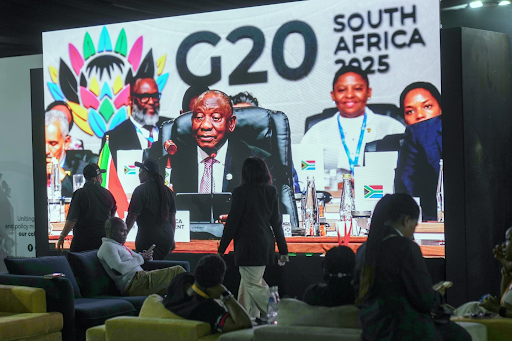
People walk by a large screen TV where the South-African President is talking to the press.
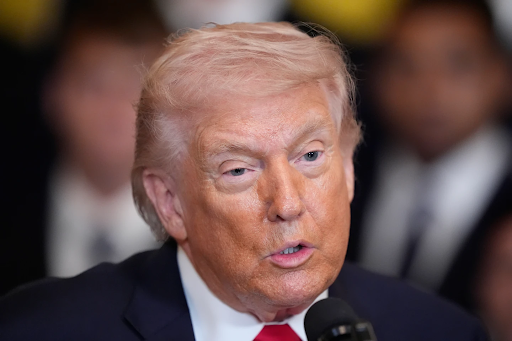
President Donald Trump announced on Wednesday that South Africa will be barred from participating in the 2026 G20 summit, which will be hosted at his Miami-area resort. The move marks a sharp escalation in tensions between Washington and Pretoria after a contentious global meeting in Johannesburg.
Trump also said the U.S. would cut all payments and subsidies to South Africa, accusing its government of mistreating a U.S. representative at this year’s summit.
Rising Tensions After Johannesburg Summit
The diplomatic dispute began when the United States boycotted the G20 summit in Johannesburg, the first ever hosted in Africa. Trump claimed he skipped the gathering due to what he described as “violent persecution” of white Afrikaners in South Africa — a claim widely rejected by the South African government as false and inflammatory.
The U.S. also refused to sign the final summit declaration, which focused heavily on issues affecting developing nations, including climate change, a topic that Trump’s administration opposed.
Trump Criticizes South Africa Over G20 Handover
In his post on Truth Social, Trump accused South Africa of refusing to hand over its G20 hosting responsibilities to a senior U.S. Embassy representative. Traditionally, the outgoing host passes a symbolic wooden gavel to the incoming president.
No American official attended the ceremony because of the boycott, and South Africa declined to hand the gavel to what it called “a junior official.”
Trump stated, “South Africa will NOT be receiving an invitation to the 2026 G20,” adding that the country had shown it was “not worthy of membership anywhere.”
G20 2026 Becomes Personal for Trump
Trump has a personal stake in next year’s G20 summit, which will take place at his Doral golf club in Florida. The decision to ban South Africa underscores both political tensions and Trump’s desire to control the narrative surrounding the high-profile global event.
As of Monday, the U.S. holds the rotating G20 presidency, leaving lingering questions about the impact of the Johannesburg declaration and broader cooperation with developing countries.
Disputes Over Treatment of White Afrikaners
Trump has repeatedly claimed that white Afrikaner farmers in South Africa face killings and land seizures. South African officials — and even some Afrikaner groups — have denounced these claims as misinformation.
The Trump administration has been increasingly critical of South Africa’s foreign policies, especially its diplomatic ties with China, Russia, and Iran, framing Pretoria as “anti-American.”
U.S. Refugee Policy Favors White South Africans
In another controversial move, the Trump administration recently limited annual refugee admissions to 7,500, reserving most spots for white South Africans. The refugee program, suspended on Trump’s first day in office, has since admitted only small numbers, almost entirely Afrikaners.
In May, the U.S. welcomed a group of 59 white South Africans as refugees.
Historical Context: Who Are the Afrikaners?
Afrikaners are descendants of Dutch, German, and French settlers who arrived in the 17th century. Although central to the apartheid era from 1948 to 1994, the group is far from uniform — some Afrikaners actively opposed apartheid.
Today, about 2.7 million Afrikaners live in a diverse South African population of 62 million.
What Comes Next for U.S.–South Africa Relations?
The decision to bar South Africa from the G20 and cut U.S. funding signals a deepening diplomatic rupture. With both countries navigating competing global alliances and domestic pressures, the fallout may shape international relations heading into the 2026 summit.
As Trump prepares to host world leaders in Miami, his administration’s stance ensures that South Africa’s absence will be one of the summit’s most significant storylines.