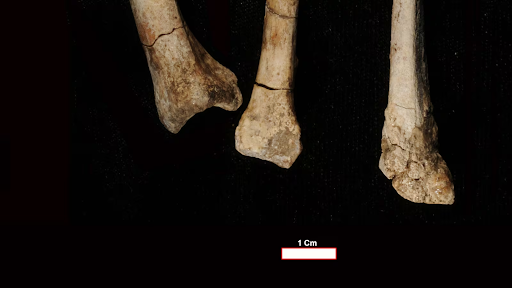
The eight bones of the Burtele foot were uncovered in 2009 by a team led by paleoanthropologist Yohannes Haile-Selassie. CNN
Scientists say they finally solved the mystery behind a set of ancient foot bones found in Ethiopia in 2009. The fossils, known as the Burtele foot, date back 3.4 million years. Experts now link them to an early human relative called Australopithecus deyiremeda, a species that lived at the same time as the famous Lucy.
Researchers also connected the foot to a jawbone with teeth found nearby. A recent study concluded that A. deyiremeda was more primitive than Lucy’s species, Australopithecus afarensis. If these findings stand, Lucy may lose her long-held position as the central figure in our human family tree.
Two Early Species Lived Side by Side
The Burtele foot was discovered near the same region where Lucy’s partial skeleton was found in the 1970s. The foot had an opposable big toe, which meant the species climbed trees easily. This key feature told scientists that the bones belonged to a different species from Lucy.
Years later, researchers uncovered additional teeth and bone fragments aged between 3.33 and 3.59 million years old. These led to the naming of Australopithecus deyiremeda in 2015, though some scientists questioned the claim at the time because the number of fossils was small.
The new study adds more fossil evidence and includes the Burtele foot as part of the species.
Scientists once believed A. afarensis—Lucy’s species—was the only early human relative between 3.8 and 3 million years ago. The new fossils show that at least two hominin species lived together in the same region. This raises new questions about how they shared resources and space.
Different Ways of Walking and Eating
The study found that A. deyiremeda walked on two legs but did so differently from modern humans. Instead of pushing off with the big toe, this species likely pushed off with the second toe.
Researchers say this shows early humans experimented with several types of upright walking.
The team also used carbon tests on eight teeth to learn about diet. The results showed that A. deyiremeda mostly ate shrubs and trees, while Lucy’s species ate a wider range of foods, including plants that grew in open areas.
This difference in walking style and diet suggests the two species did not compete for the same resources.
A Possible Shift in the Human Family Tree
A scientist who reviewed the study noted that the findings may change how researchers understand human evolution. If A. deyiremeda descended from Australopithecus anamensis, an older species, then Lucy may not sit at the root of the human family tree after all.
Other fossil comparisons suggest that multiple species may have branched out from A. anamensis, not just Lucy’s line.
Some experts say these findings could cause major debate in the scientific community. Others caution that more discoveries are needed to prove which species led to modern humans. Some even suggest Lucy’s species may have been an evolutionary dead end.
Search for More Evidence Continues
Scientists plan to return to the region for more fieldwork. They hope to find additional fossils from both A. deyiremeda and A. anamensis. New discoveries may help explain how these species lived, how they evolved, and which ones contributed to the lineage of modern humans.“We need more fossils of A. deyiremeda and A. anamensis to answer the questions we still have about them,” the lead researcher said.