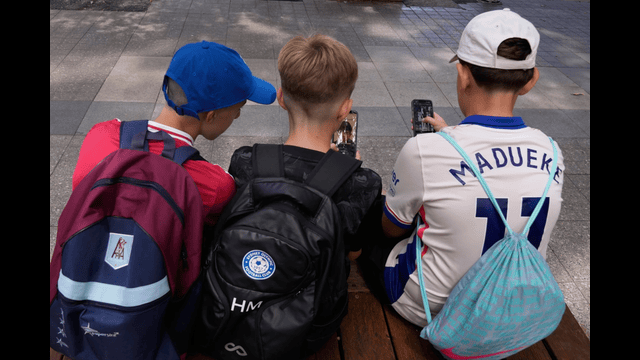
Hugo Winwood-Smith, right, Hardy Macpherson and Edan Abou, left, all 11-years-old, use their phones while sitting outside a school in Sydney, Monday, Dec. 8, 2025
Australia has officially enacted its social media ban for children under 16, marking a global first in online safety regulation. The law took effect Wednesday, sparking relief among parents and frustration among children suddenly locked out of their accounts. The government says the reform empowers families, though officials admit the rollout will be challenging.
A Landmark Shift for Australian Families
Prime Minister Anthony Albanese hailed the ban as a decisive step in “giving childhood back to Australian kids.” He said families were reclaiming control from tech giants, calling the reform a global signal of stronger accountability.
Parents reported mixed reactions at home. Many children were distraught after discovering their accounts had vanished overnight. Others attempted to bypass the system by manipulating age estimation tools, even drawing fake facial hair to fool algorithmic checks.
Albanese acknowledged the implementation “won’t be perfect,” but insisted the change was overdue.
Platforms Face Heavy Penalties Under the Social Media Ban
The social media ban for children under 16 applies to major platforms including Facebook, Instagram, TikTok, Snapchat, YouTube, X, Reddit, Threads, Kick and Twitch. Each faces fines of up to AUD 49.5 million (USD 32.9 million) if they fail to take “reasonable steps” to remove underage accounts.
Australia’s eSafety Commissioner Julie Inman Grant will oversee enforcement. She confirmed that platforms already possess the data and technological capacity to verify age accurately.
Beginning Thursday, her office will issue notices demanding information on compliance efforts, including how many accounts have been closed.
“We will update the public before Christmas on whether the social media ban is working,” she said.
Thousands of Accounts Already Removed
Communications Minister Anika Wells said early data shows significant enforcement. More than 200,000 Australian TikTok accounts belonging to children under 16 were shut down by Wednesday.
She warned that children using VPNs or borrowed identities may avoid detection briefly, but not for long. Platforms are required to routinely re-check their user base, meaning underage accounts will eventually be flagged.
Wells gave an example: a child using a VPN to appear in Norway may still reveal their actual location by posting images from Australian beaches.
“Just because they avoided it today doesn’t mean they’ll avoid it next week,” she said.
Families, Advocates and Critics Respond
Supporters of the social media ban say it is a life-saving reform.
Wayne Holdsworth, whose son Mac died by suicide after a sextortion scam, called the law a critical first step.
“Our kids who we’ve lost haven’t died in vain,” he said, addressing a Sydney gathering of supporters.
Twelve-year-old advocate Flossie Brodribb praised the nation’s leadership. She believes the ban will help children grow up “healthier, safer, kinder and more connected to the real world.”
However, not all families are celebrating.
Simone Clements, mother of 15-year-old twins active in the entertainment industry, fears significant financial consequences. Her children work as actors, models and influencers, relying on social media to showcase their portfolios.
“This is an income stream for them,” she said. “Losing their young followers will hurt.”
Global Eyes on Australia’s New Online Safety Model
Albanese believes other countries will study Australia’s bold move closely. With rising concerns around cyberbullying, exploitation, addiction, and mental health, the social media ban for under-16s could inspire international policy changes.
But the prime minister reiterated that, despite difficulties, the responsibility of big tech must be addressed.
“This is about pushing back,” he said. “Social media companies have a social responsibility.”
As enforcement ramps up through Christmas, Australia now enters a new phase of child protection—one watched closely by the world, celebrated by supporters, and challenged by families navigating the realities of a digital age without underage access.