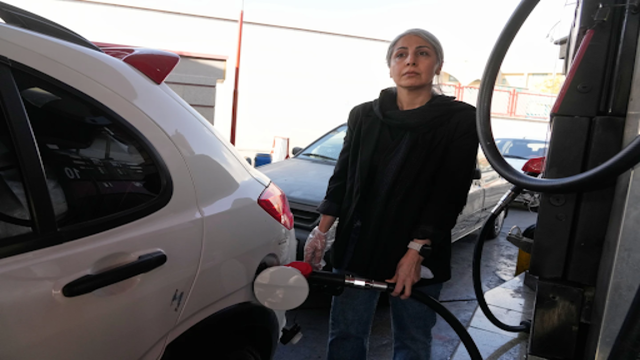
A woman fills her car at the gas station in Tehran, Iran. Associated Press
Iran has raised gasoline prices for the first time since the deadly 2019 protests, introducing a new pricing tier on Saturday. The move aims to control ballooning subsidy costs while avoiding fresh unrest in a country strained by inflation, sanctions, and recent conflict.
Cheap fuel has long been treated as a public right in Iran. Any price change carries political and social risk.
A Sensitive Shift After Years of Stability
The government’s decision marks a cautious adjustment, not a dramatic hike. Officials appear determined to avoid repeating the turmoil seen in 2019, when fuel price increases triggered nationwide protests and a violent crackdown.
The timing also reflects public fatigue following a 12-day war with Israel in June, which heightened economic anxiety across the country.
How the New Gasoline Pricing Works
Iran’s revised fuel system now includes three pricing tiers under its national subsidy program.
Motorists will continue receiving 60 liters per month at the lowest subsidized rate. That price remains 15,000 rials per liter, or roughly 1.25 U.S. cents.
The next 100 liters stay priced at 30,000 rials per liter, or about 2.5 cents.
Any fuel purchased beyond that limit now costs 50,000 rials per liter, close to 4 U.S. cents.
Even with the new tier, Iran still offers some of the cheapest gasoline in the world.
Subsidies Strain an Ailing Economy
Fuel subsidies place heavy pressure on Iran’s budget. The gap between production costs and pump prices is paid by the state.
The International Energy Agency ranked Iran as the world’s second-largest energy subsidizer in 2022, after Russia. Oil subsidies alone reached $52 billion that year.
Iranian officials admit tens of billions are spent annually to keep energy prices artificially low.
Economists Warn of Long-Term Damage
Tehran-based economist Hossein Raghfar said gasoline prices have increased 15 times since 2009, yet fiscal problems remain unresolved.
He argued subsidies have worsened inflation and entrenched budget deficits instead of easing them.
Critics warn that every 10,000-rial fuel increase could add up to 5% inflation. Iran already faces inflation near 40% annually.
Public Reaction Reflects Frustration
Many Iranians see the move as unavoidable but unfair.
“Our discontent has no result,” said Saeed Mohammadi, a teacher who drives a taxi part-time. “The government decides without asking people.”
Others accept the hike as an indirect tax. Hamid Rezapour, a bank teller, said the state needs revenue to fund public services, even if the policy feels ineffective.
Fuel Prices and Employment Ties
Cheap gasoline supports widespread informal employment. Iran has 25 million vehicles and 6 million motorbikes.
More than 8 million people reportedly work as taxi drivers through online platforms. That equals nearly 10% of the population.
Officials worry sudden price shocks could disrupt livelihoods tied to transportation.
Memories of 2019 Still Linger
The last major fuel hike in 2019 raised prices sharply and sparked protests in over 100 cities.
Security forces responded forcefully. Amnesty International reported at least 321 deaths and thousands detained.
Those memories continue to shape government caution today.
What Comes Next
Oil Minister Mohsen Paknejad called the new pricing system a starting point for managing fuel consumption.
Officials review gasoline prices every three months, signaling possible future increases.
Many citizens remain skeptical. “People protested before,” said Mohammad Reza Assadi, a veteran taxi driver. “They went home tired and hopeless.”
For now, Iran walks a narrow line between economic necessity and social stability.