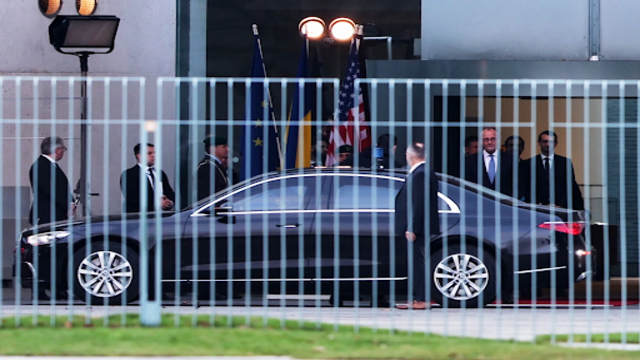
German Chancellor is watching the Ukrainian president arriving at the Chancellery in Berlin, Germany. Associated Press
European leaders are preparing to reaffirm their backing for Ukraine as pressure mounts from Washington to accept a rapid peace deal. The diplomatic push comes amid growing concern over Europe’s long-term security and Russia’s continued aggression.
Talks are intensifying across European capitals following high-level meetings in Berlin. The discussions aim to align European strategy while responding to U.S. efforts to end the nearly four-year war.
High-Stakes Talks in Berlin
Ukrainian President Volodymyr Zelenskyy met U.S. envoys in Berlin on Sunday. The meeting included Steve Witkoff, President Donald Trump’s special envoy, and Jared Kushner, Trump’s son-in-law.
The talks focused on exploring pathways to end the conflict while balancing Ukrainian sovereignty and Western security interests. European and Ukrainian officials are continuing discussions on Monday to strengthen a united front.
Washington Pushes for a Swift Deal
The United States has spent months trying to broker peace between Kyiv and Moscow. President Trump has grown increasingly frustrated by delays and unresolved disagreements.
One major obstacle remains Ukraine’s eastern Donetsk region, much of which is occupied by Russian forces. Washington has reportedly pressed Kyiv to consider territorial concessions, a proposal Ukraine continues to reject.
Ukraine Signals Flexibility, Draws Red Lines
Zelenskyy signaled readiness to abandon Ukraine’s NATO membership bid if strong Western security guarantees are provided. He stressed these guarantees must resemble NATO protections.
However, Ukraine firmly rejected any proposal involving the ceding of territory to Russia. Kyiv insists sovereignty and territorial integrity are non-negotiable.
Russia, meanwhile, demands that Ukrainian forces withdraw from remaining parts of Donetsk under Kyiv’s control. This condition remains a key stumbling block.
NATO at the Center of the Dispute
Russian President Vladimir Putin has repeatedly framed Ukraine’s NATO ambitions as a threat to Russian security. The Kremlin has demanded Ukraine formally renounce alliance membership as part of any peace agreement.
Zelenskyy responded by insisting that any security assurances must be legally binding. He also emphasized the need for approval by the U.S. Congress to ensure credibility.
Europe Reassesses Its Security Role
German Chancellor Friedrich Merz warned that Europe can no longer rely on U.S. protection alone. Speaking at a party conference, he declared that the era of “Pax Americana” is largely over for Europe.
Merz cautioned that Putin seeks to redraw Europe’s borders and restore Soviet-era influence. “If Ukraine falls, he won’t stop,” Merz warned.
France and Britain Stand Firm
French President Emmanuel Macron reaffirmed France’s commitment to Ukraine. Writing on social media, he vowed long-term support for a peace that guarantees Ukraine’s security and sovereignty.
The United Kingdom has echoed similar views, emphasizing that any settlement must deter future Russian aggression and protect Europe’s stability.
Russia Rejects European Fears
Putin has denied having plans to attack NATO or European allies. The Kremlin continues to frame the war as a defensive response to Western expansion.
European leaders remain unconvinced. Many see Ukraine as the frontline defense for broader European security.
What Comes Next
European officials are expected to finalize a coordinated stance supporting Ukraine in the coming days. The goal is to balance U.S. diplomacy with firm resistance to Russian demands.
As negotiations continue, Ukraine’s future, Europe’s security, and the global balance of power remain tightly linked.