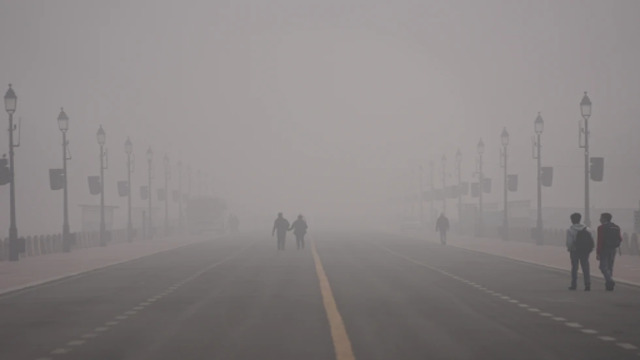
People walk through smog in New Delhi, India, Dec. 15, 2025. Associated Press
India’s air quality crisis is deeper than official numbers suggest. Recent comments from senior leaders have reignited public anger. Many residents believe policymakers are downplaying dangerous pollution levels. Critics say unreliable data masks the true scale of India’s worsening air quality emergency.
Controversial Claims Spark Backlash
Earlier this month, Environment Minister Bhupender Yadav told Parliament that New Delhi recorded 200 days of good air quality. Pollution experts quickly challenged the claim. They argued the figure excluded peak pollution months.
Soon after, Delhi Chief Minister Rekha Gupta compared the air quality index to temperature readings. She suggested water spraying could manage pollution. The remark triggered public outrage. Crowds later mocked her by chanting “AQI” at a public event.
Gupta also approved a cloud seeding program, claiming artificial rain could reduce pollution. Experts said evidence supporting this approach is weak.
Citizens Choking on Toxic Smog
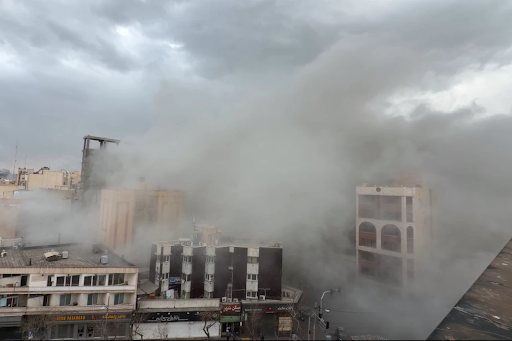
Residents across Delhi and neighboring areas say denial has replaced action. Thick smog has blanketed the city for months. Many people report breathing difficulties and reduced work capacity.
“Instead of cloud seeding, the government should take real action,” said Anita, a 73-year-old Delhi resident. “This situation is shameful.”
For many, official statements feel disconnected from daily reality. People say pollution is no longer seasonal but constant.
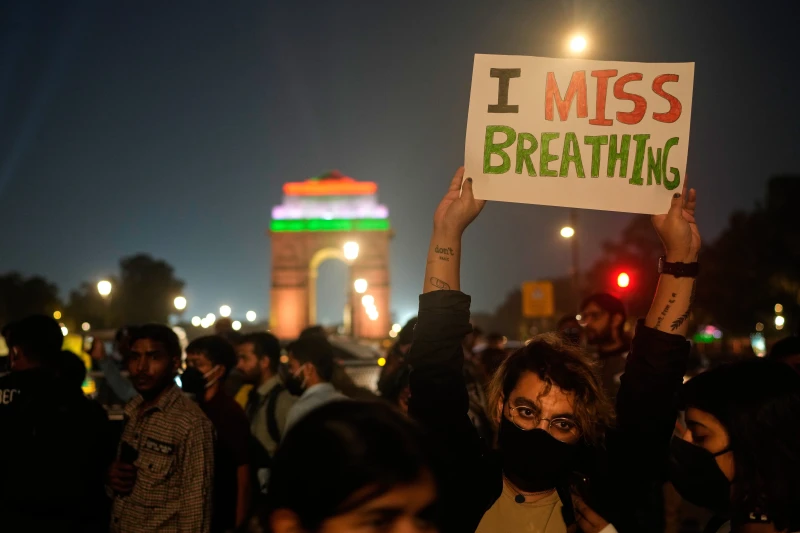
A person holds a sign during a protest against what they called the government’s lack of action to combat air pollution in New Delhi, India, Nov. 9, 2025.
Why Air Quality Data Falls Short
India measures air quality using ground monitors, sensors, and satellite data. Experts say the system is incomplete.
“There are too few monitors to reflect neighborhood-level pollution,” said Ronak Sutaria, CEO of Respirer Living. He warned citizens often lack accurate local information.
Environmental groups also criticize India’s looser pollution standards. These benchmarks are weaker than U.S. limits and WHO guidelines. As a result, “moderate” readings may still mean dangerous exposure.
Experts say these gaps erode public trust and hide health risks.
National Clean Air Program Under Scrutiny
India launched the National Clean Air Program in 2019. It aimed to cut pollution by up to 40% in 131 cities by 2026.
The program funded monitoring systems and dust-control measures. Water spraying reduced road and construction dust in several areas.
However, experts say major pollution sources remain ignored. These include vehicle emissions, coal-based industries, crop burning, and garbage fires.
A 2024 report by the Centre for Science and Environment revealed troubling priorities. About 64% of funds targeted dust reduction. Only 12% addressed vehicle pollution. Less than 1% focused on industrial emissions.
“Monitoring expansion must match data quality,” said Anumita Roychowdhury of the think tank.
Air Pollution as a Public Health Emergency
The health toll of air pollution is severe. A Lancet study linked polluted air to 1.5 million extra deaths annually in India. The estimate compared current exposure to WHO standards.
Despite this, junior health minister Prataprao Jadhav said no conclusive data links deaths exclusively to pollution.
Health advocates disagree strongly. “Deaths aren’t counted because systems don’t exist,” said Shweta Narayan of the Global Climate and Health Alliance.
She warned pollution harms everyone but hits pregnant women, children, and elderly hardest. Long-term exposure increases miscarriages, preterm births, and lifelong health issues.
Rising Protests and Political Pressure
Public frustration is turning visible. Delhi recently saw rare street protests demanding urgent action.
“Citizens are fed up,” said environmentalist Vimlendu Jha. He accused leaders of managing headlines instead of pollution.
Jha stressed honesty as the first solution. “The right diagnosis is critical,” he said.
Lives and Livelihoods at Risk
For many workers, pollution is already changing daily life. Satish Sharma, a 60-year-old auto rickshaw driver, reduced his working hours. His health has worsened during recent smog spells.
“People cannot work or even breathe,” Sharma said. “Please do something, or people will leave.”
India’s air quality crisis is no longer invisible. Citizens are demanding truth, accountability, and urgent action before the damage becomes irreversible.