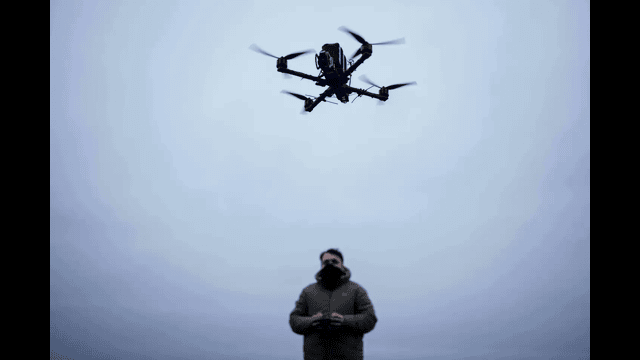
A serviceman controls an FPV drone of “General Cherry” company at the polygon in Ukraine, on Dec. 4, 2025.
The frozen ground crunches under boots as Ukrainian soldiers prepare for another sleepless night.
They assemble antennas, sensors, and monitors in silence.
A small interceptor drone waits nearby, ready for launch.
This scene reflects a major shift in Ukraine’s air defense, driven by cheap and powerful drone killers.
A New Weapon Takes Shape
Known as the Sting, the interceptor resembles a flying thermos.
It is compact, fast, and deadly precise.
Ukrainian forces designed it to hunt enemy suicide drones in midair.
The interceptor belongs to a new generation of homegrown drone killers.
These systems counter Russian drones that now fly faster and higher.
Protecting Cities and Power Grids
Ukraine faces nightly drone attacks on cities and energy infrastructure.
Each interception saves homes, families, and power plants.
“Every destroyed target is one less strike on civilians,” said a commander using the call sign Loi.
“The enemy does not sleep, and neither do we.”
From Prototype to Production
Ukraine’s interceptor drones moved from testing to mass production within months in 2025.
This speed highlights how modern warfare now rewards adaptation and scale.
Rather than relying on expensive missiles, Ukraine layers low-cost systems into its defenses.
These drones cost as little as $1,000 each.
How Interceptor Drones Work
Models like the Sting and the Bullet accelerate rapidly before crashing into enemy drones.
Operators fly them using monitors or first-person-view goggles.
Volunteer-driven startups power much of this innovation.
Companies like Wild Hornets and General Cherry lead production.
Winning the Economic Battle
Cost efficiency matters as much as battlefield success.
According to General Cherry strategist Andrii Lavrenovych, targets destroyed can cost up to $300,000.
“We are inflicting serious economic damage,” he said.
Cheap interceptors force Russia into an expensive war of attrition.
Russia’s Evolving Drone Threat
Russia relies heavily on Iranian-designed Shahed drones.
These platforms now feature jammers, cameras, and turbojet engines.
Innovation moves quickly on both sides.
“In some areas, they lead. In others, we respond and they suffer,” Lavrenovych said.
Experts See a Strategic Shift
Defense analysts say interceptor drones are reshaping air defense.
Federico Borsari of the Center for European Policy Analysis calls them essential.
“Cheap interceptor drones are now a cornerstone of counter-drone warfare,” he said.
“They realign the cost and scale equation of air defense.”
Not a Silver Bullet
Despite their success, interceptor drones have limits.
They depend on sensors, trained operators, and fast command systems.
Borsari warned against overreliance on a single solution.
Effective defense still requires missiles, guns, and layered protection.
Europe’s Emerging Drone Wall
Ukraine’s experience is shaping NATO planning.
European defense leaders expect drone production to surge in 2026.
This urgency fuels plans for a “drone wall” along Europe’s eastern borders.
The network will detect, track, and destroy aerial threats.
Ukrainian-style interceptors may play a central role.
Global Partnerships Take Shape
Ukrainian drone makers plan to expand coproduction with U.S. and European firms next year.
These partnerships combine battlefield data with Western manufacturing scale.
The effort could embed Ukraine deeply into NATO supply chains.
Automation Is the Next Frontier
Developers also push toward autonomous drone defense.
Lavrenovych believes automation will protect frontline teams.
“Mobile groups should not risk exposure near the front,” he said.
“Drones must become autonomous robots to help soldiers survive.”
As Ukraine rewrites air defense doctrine, cheap drone killers now define the future of modern warfare.