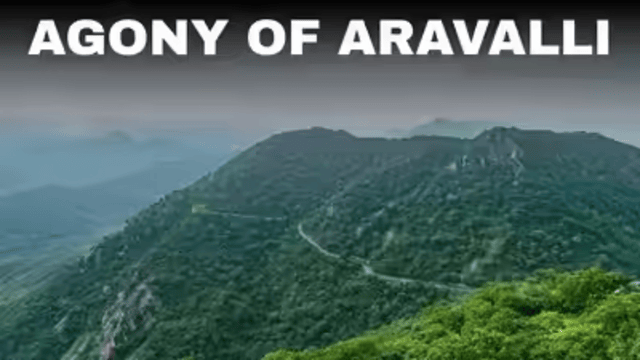
A photo of Aravalli: A Mountain older than memory
The Centre on Sunday dismissed allegations that the newly defined Aravalli range would open the area to large-scale mining. The government stated that more than 90% of the Aravalli region will remain protected, citing a Supreme Court-approved framework and an ongoing freeze on new mining leases.
Supreme Court Framework Strengthens Protection
The Supreme Court had approved a framework designed to enhance the conservation of the Aravalli hills and ranges. Under this framework, new mining leases remain suspended until a comprehensive management plan is finalized.
Environment Minister Bhupender Yadav clarified that no relaxation has been granted regarding Aravalli protection. Responding to media queries after a meeting on Project Elephant and the National Tiger Conservation Authority, Yadav emphasized that misinformation has been circulating regarding the new definition.
Protected Area Coverage
According to Yadav, in the total Aravalli area of 1.44 lakh sq km, only 0.19% is eligible for mining. The remainder of the mountain system is safeguarded. He reiterated, “Stop spreading misinformation!” on social media, countering allegations by opposition parties that the changes would harm the region.
Defining Aravalli Hills and Ranges
The government’s definition standardizes terms across states as per Supreme Court directives. An Aravalli Hill is defined as any landform in designated districts with an elevation of 100 metres or more above local relief. An Aravalli Range comprises two or more such hills within 500 metres of each other.
Officials clarified that the 100-metre criterion does not open areas below this height for mining. The protection applies to entire hill systems, including the lowest bounding contours and the spaces between hills.
Committee Recommendations and State Adoption
A committee under the Ministry of Environment, Forests, and Climate Change was formed in May 2024 to recommend a uniform definition due to inconsistent criteria across states. The committee, chaired by the Environment Ministry Secretary, included representatives from Rajasthan, Haryana, Gujarat, and Delhi.
Only Rajasthan had an established definition since 2006, which treats landforms rising 100 metres or more as hills and prohibits mining within the lowest contour enclosing such hills. This definition, adopted now by all four states with added safeguards, strengthens protection across the Aravalli landscape.
Core and Inviolate Areas
The government stated that core and inviolate areas, including eco-sensitive zones, tiger reserves, wetlands, and protected areas, will remain off-limits for mining. Limited exemptions are allowed only for critical or strategic deep-seated minerals in the national interest.
Additionally, all hills within 500 metres of each other are considered part of the range. Mapping by the Survey of India and clear identification of protected zones will guide mining decisions.
Managing Mining and Illegal Activities
The Supreme Court has mandated preparation of a Management Plan for Sustainable Mining by the Indian Council of Forestry Research and Education. Existing mines may operate only if they comply with strict sustainable mining norms.
Illegal and unregulated mining remains the primary threat. Authorities plan to enhance monitoring using drones, surveillance technology, and stricter enforcement, according to government sources.
Key Takeaways
- Over 90% of Aravalli region protected under new Supreme Court-approved definitions.
- Mining eligibility limited to 0.19% of the total area.
- Core zones, eco-sensitive areas, and reserves remain off-limits.
- States have adopted standardized definitions for clarity and enforcement.
- Illegal mining monitored with modern technology and stronger oversight.
Minister Yadav reaffirmed the government’s commitment to preserving the Aravalli mountains through ongoing initiatives like the Green Aravalli movement, insisting that protection remains a top priority despite circulating misinformation.