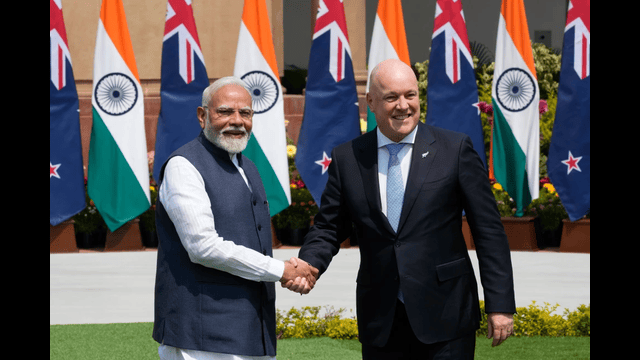
Indian Prime Minister Narendra Modi, left, greets visiting New Zealand Prime Minister Christopher Luxon before their meeting in New Delhi, India, Monday, March 17, 2025.
India and New Zealand have finalized a free trade agreement, aiming to strengthen economic ties as global trade faces uncertainty. The deal reflects a shared intent to boost growth, diversify markets, and reduce reliance on traditional trading partners during volatile times.
The agreement was announced on Monday after nine months of negotiations. A formal signing is expected in the first quarter of next year, following legal review of the text.
A Strategic Trade Move
The India–New Zealand free trade agreement arrives as New Delhi accelerates efforts to diversify export destinations. This strategy seeks to counter the impact of rising protectionism and steep U.S. import tariffs affecting Indian exporters.
Officials say the pact lowers tariffs, eases regulatory barriers, and expands cooperation across goods, services, and investments. It also reflects India’s broader push to secure partnerships beyond its traditional markets.
Market Access and Tariff Gains
Under the deal, India will receive zero-duty access for all its goods exported to New Zealand. In return, Wellington will gain tariff concessions and market access across about 70% of India’s tariff lines, covering nearly 95% of New Zealand exports in a phased manner.
Indian sectors set to benefit include textiles, apparel, engineering goods, leather, footwear, and marine products. New Zealand’s key gains include horticulture, wood, coal, sheep wool, and meat exports.
Investment Commitments Strengthen Ties
New Zealand has committed $20 billion in investments in India over the next 15 years, according to India’s Trade Ministry. Officials view this as a long-term signal of confidence in India’s growth prospects and manufacturing base.
Despite the agreement, India has excluded dairy products such as milk, cheese, and yoghurt. Certain animal and vegetable items were also kept out, citing domestic sensitivities.
Trade Volume and Growth Potential
Bilateral trade between India and New Zealand remains modest compared to India’s major partners. Two-way trade in goods and services stood at $2.4 billion in 2024. Both sides aim to double this figure within five years.
Trade analysts describe the agreement as a framework for deeper cooperation, rather than a dramatic trade breakthrough. They note its long-term value lies in market access and investment flows.
Leaders React to the Agreement
New Zealand Prime Minister Christopher Luxon confirmed discussions with Indian Prime Minister Narendra Modi following the deal’s conclusion. He said New Zealand’s exports to India could rise by $1.1 billion to $1.3 billion annually over the next two decades.
Trade Minister Todd McClay highlighted unique gains, noting New Zealand became the first country to secure apple and honey access to India under an FTA.
India’s Trade Minister Piyush Goyal said the pact shows India’s focus on partners that complement, rather than compete with, its economy.
India’s Expanding Trade Network
India views a wider web of trade agreements as protection against external economic shocks. In recent months, it has accelerated negotiations with the European Union, Chile, and Canada.
This push follows pressure from new U.S. tariffs, including an added 25% levy linked to India’s Russian oil imports. These measures have affected sectors like textiles, auto components, and metals.
India has already signed trade agreements with the UAE, Australia, the UK, and Oman, significantly boosting bilateral trade.
Looking Ahead
As global trade becomes more unpredictable, the India–New Zealand free trade agreement signals a shared commitment to openness and long-term cooperation. Both nations now look toward implementation, hoping the deal delivers sustained growth, resilience, and new economic opportunities.