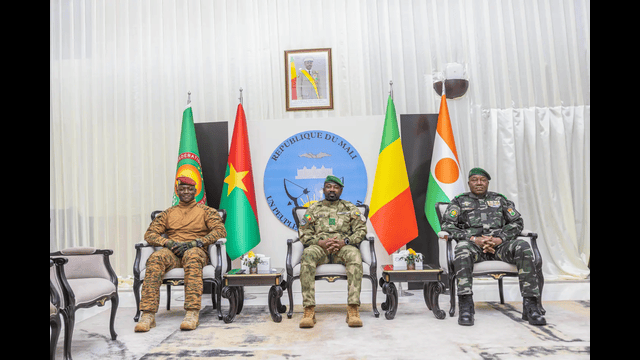
Captain Ibrahim Traoré of of Burkina Faso, left, General Assisi Gotta of Mali, and general Abdourahamane Tchiani of Niger attend the second summit on security and development in Bamako, Mali, Tuesday, Dec 23, 2025.
The Alliance of Sahel States has signaled a tougher military push against extremist violence.
Mali, Burkina Faso, and Niger want joint large-scale operations to follow their new battalion launch.
Leaders say coordinated action is urgent in one of the world’s deadliest extremist hotspots.
Joint Force Signals Escalation
Burkina Faso’s leader, Capt. Ibrahim Traoré, announced plans for expanded military action.
He spoke after being named head of the Alliance of Sahel States.
Traoré said the new joint battalion must lead to large-scale operations soon.
He did not share operational timelines or target locations.
The Alliance of Sahel States was created in 2023.
It unites Mali, Burkina Faso, and Niger under military-led governments.
All three countries withdrew from West Africa’s regional bloc earlier this year.
Their exit marked a major shift in regional politics and security cooperation.
Sahel Extremism Remains Deadly
The Sahel region has become the world’s most lethal zone for extremist violence.
Armed groups linked to al-Qaida and the Islamic State operate across vast borders.
Mali, Burkina Faso, and Niger are among the hardest-hit nations.
Civilians and security forces face frequent attacks.
Each country has suffered military coups in recent years.
Their security forces remain overstretched and under constant pressure.
Despite these challenges, leaders insist joint action can change the battlefield.
Summit Backs Security and Economic Ties
Leaders met Tuesday for a high-level summit of the Alliance of Sahel States.
They agreed to deepen both security and economic cooperation.
The talks came days after the launch of the joint military battalion.
The force is expected to include around 5,000 troops.
Officials say the battalion will strengthen cross-border coordination.
It is designed to respond faster to extremist threats.
Leaders view unity as essential against mobile armed groups.
Ending Foreign Military Presence
Niger’s junta leader, Abdourahamane Tchiani, highlighted a major policy shift.
He said alliance members ended the presence of “occupation forces.”
His remarks referred to decisions to expel France and the United States.
Both countries were long-time security partners in the region.
Tchiani said Sahel states would now decide their own future.
“No country or interest group will decide for us anymore,” he said.
The message reinforced the alliance’s emphasis on sovereignty and self-rule.
Russia Emerges as Key Ally
As Western forces exited, the Sahel alliance turned toward Russia.
Mali, Burkina Faso, and Niger now see Moscow as a major security partner.
This realignment has reshaped regional and international relations.
It also sparked debate about long-term security outcomes.
Experts Urge Caution
Analysts warn the Sahel security crisis remains extremely complex.
Rida Lyammouri, a Sahel specialist, said extremism is hard to defeat.
He noted this challenge persists regardless of foreign partners involved.
Local conditions and governance issues still matter.
Another expert highlighted the alliance’s growing unity.
Ulf Laessing of the Konrad Adenauer Foundation cited strong citizen support.
He said cooperation continues despite sanctions and strained global ties.
The alliance is also expanding beyond purely military coordination.
Momentum Beyond the Battlefield
The Alliance of Sahel States aims to maintain political and public momentum.
Leaders want deeper economic and social collaboration.
They believe stability requires more than military force alone.
For now, joint large-scale operations remain their most urgent priority.