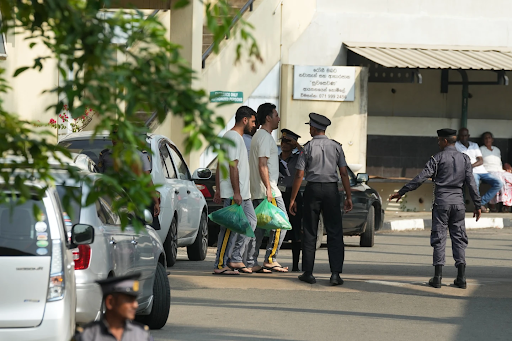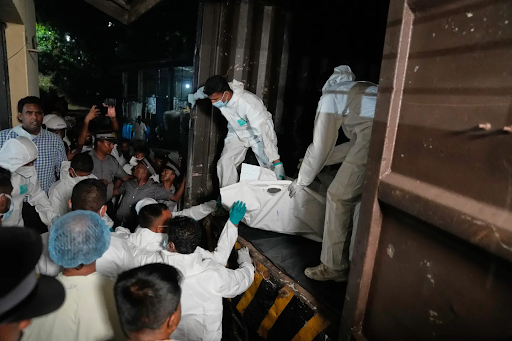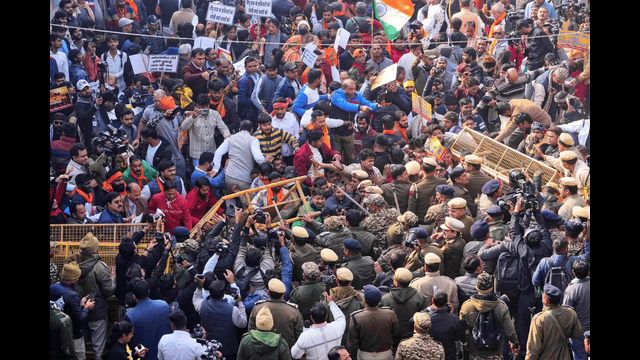
Police officers try to stop activists of Vishwa Hindu Parishad, a prominent right-wing Hindu nationalist organization, crossing over barricades during a protest near Bangladesh High Commission accusing Bangladeshi groups of wrongly targeting Indians, in New Delhi, India, Tuesday, Dec. 23, 2025.
A protest broke out in India’s capital after the brutal lynching of a Hindu man in Bangladesh.
The incident has triggered fresh diplomatic strain between the two neighboring countries.
Demonstrations in New Delhi reflected growing anger over minority safety across the border.
The episode has also exposed cracks in a relationship once seen as stable in South Asia.
Protest Near Bangladesh High Commission
Hundreds of protesters gathered near the Bangladesh High Commission in New Delhi on Tuesday.
The protest was led mainly by the Hindu nationalist group Vishva Hindu Parishad.
Demonstrators raised slogans accusing Bangladeshi groups of targeting Hindu minorities.
Placards warned that India would not tolerate violence against Hindus in Bangladesh.
Security was tightened across the diplomatic enclave.
Police erected barricades and deployed armored vehicles.
Some protesters attempted to breach security lines.
Police used batons to prevent entry into the mission area.
Lynching Incident Sparks Outrage
The protest followed the killing of Dipu Chandra Das, a 25-year-old Hindu man.
He was lynched and burned publicly in Bangladesh’s Mymensingh district.
The attack reportedly followed allegations of blasphemy.
The incident sent shockwaves through India and Bangladesh alike.
Das’s killing deepened fear among Bangladesh’s Hindu community.
Minority groups reported a growing sense of insecurity after recent political changes.
The lynching became a flashpoint for the India-Bangladesh protest in New Delhi.
Violence After Student Leader’s Death
Tensions escalated earlier after the death of Bangladeshi student leader Sharif Osman Hadi.
Hadi died in a Singapore hospital after being shot in Dhaka on December 12.
Bangladesh police said the suspected shooter fled the country.
Authorities believe the suspect crossed into India.
Hadi’s death sparked unrest in Dhaka.
Angry mobs torched newspaper offices and targeted Indian diplomatic sites.
Amid this violence, a Hindu man was burned alive.
That killing directly triggered protests in India’s capital.
Political Background Adds Complexity
Hadi was linked to Bangladesh’s 2024 political uprising.
The movement ended the 15-year rule of former Prime Minister Sheikh Hasina.
Hasina fled the country in August and remains in exile.
Hadi was a strong critic of both Hasina and India.
He planned to contest national elections scheduled for February.
His death has now become a diplomatic flashpoint.
India summoned Bangladesh’s envoy over security concerns.
Diplomatic Exchanges Intensify
Bangladesh also responded with its own diplomatic move.
It summoned India’s high commissioner in Dhaka.
Officials discussed security at Bangladeshi missions in India.
Concerns focused on New Delhi, Kolkata, and Agartala.
These exchanges highlight worsening India-Bangladesh relations.
Once-close ties now face renewed uncertainty.
Minority Safety and Government Response
Religious minorities in Bangladesh raised serious allegations.
Hindu and Christian groups accused the interim government of inaction.
The administration is led by Nobel laureate Muhammad Yunus.
Officials have firmly denied claims of neglect.
Still, fears persist among minority communities.
The lynching has become symbolic of wider anxieties.
Regional Impact and Expert View
Experts warn the India-Bangladesh protest could have broader consequences.
Trade cooperation and border management may suffer setbacks.
Regional connectivity efforts could also slow.
Analyst Sreeram Sundar Chaulia noted rising political polarization.
He warned against growing Islamist and exclusionary narratives.
Chaulia said Bangladesh risks losing Indian support and markets.
India, meanwhile, faces a setback in its regional strategy.
Bangladesh could drift closer to China amid economic pressure.
Once-Warm Ties Under Strain
India and Bangladesh shared strong ties since 2009.
Relations flourished during Sheikh Hasina’s tenure.
Bilateral trade and development cooperation expanded steadily.
However, critics accused Hasina of being too close to India.
Her removal reopened old fault lines.
The latest India-Bangladesh protest signals a fragile future for bilateral ties.