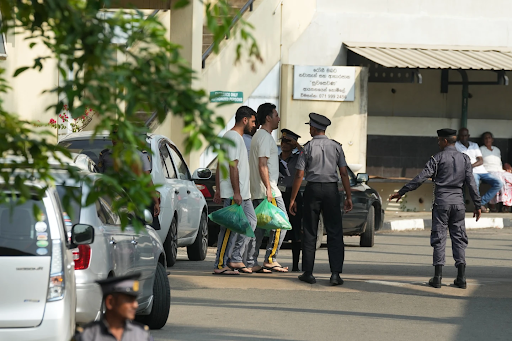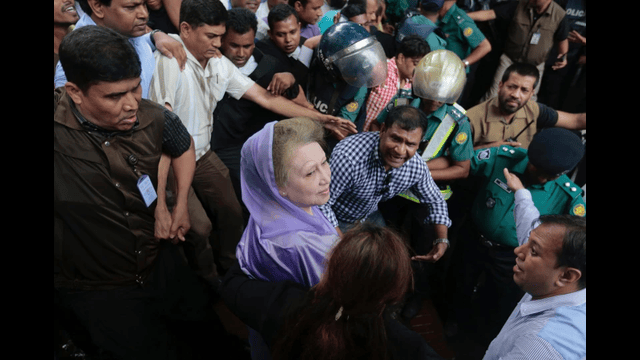
Bangladesh’s former prime minister and Bangladesh Nationalist Party leader Khaleda Zia, center, leaves court after a hearing in Dhaka, Bangladesh, Aug. 10, 2016.
Former Bangladeshi Prime Minister Khaleda Zia has died at the age of 80.
Her death marks the end of a political era shaped by rivalry, resistance, and repeated power shifts.
Zia’s long contest with Sheikh Hasina defined Bangladesh’s politics for decades.
The Bangladesh Nationalist Party confirmed her death on Tuesday.
She was Bangladesh’s first woman elected prime minister.
Her rise changed the country’s political landscape and inspired many women leaders.
Khaleda Zia’s Early Political Journey
Khaleda Zia entered politics after personal tragedy and national turmoil.
Her husband, President Ziaur Rahman, seized power in 1977 as army chief.
He later formed the Bangladesh Nationalist Party, promising democratic reforms.
His assassination in a 1981 military coup altered Zia’s life and role forever.
Bangladesh’s early independence years were violent and unstable.
Coups and countercoups shaped governance after the 1971 liberation war.
Zia emerged as a civilian face against military dominance.
Leading the Fight Against Military Rule
Khaleda Zia became a key figure opposing military dictatorship.
Her firm stance helped unite political forces against authoritarian rule.
That movement eventually toppled military ruler H.M. Ershad in 1990.
The uprising restored democratic elections in Bangladesh.
Prime Minister and Political Rivalry
Zia first became prime minister in 1991.
Her main rival was Sheikh Hasina, daughter of independence leader Sheikh Mujibur Rahman.
Their rivalry dominated elections, protests, and policy debates for years.
In early 1996, Zia won a disputed election amid widespread boycotts.
Her government lasted only 12 days.
A caretaker administration soon oversaw fresh polls.
She returned to power in 2001.
That government included the Islamist Jamaat-e-Islami party.
The alliance drew criticism due to the party’s controversial wartime past.
Policies, Criticism, and Regional Tensions
Zia’s administration followed pro-investment and open-market policies.
Business leaders largely backed her economic approach.
However, critics questioned her foreign policy positions.
She was seen as sympathetic toward Pakistan.
She often delivered strong anti-India political speeches.
India accused her government of allowing insurgents safe haven, especially from 2001 to 2006.
Corruption Allegations and Family Controversies
Zia’s later years were clouded by corruption allegations.
Her elder son, Tarique Rahman, was accused of running a parallel government.
He also faced widespread corruption claims.
Zia herself was sentenced to 17 years in prison.
The charges involved misuse of funds from a charity named after her husband.
The BNP insisted the cases were politically motivated.
In January 2025, the Supreme Court acquitted her in the final corruption case.
The verdict cleared her path to contest national elections.
Health, Prison Release, and Final Return
Health concerns eventually outweighed political conflict.
Zia was released from prison in 2020 due to illness.
She remained confined to a rented home and hospital visits.
Her family requested permission for overseas treatment at least 18 times.
The Hasina government rejected every appeal.
After Hasina’s ouster in 2024, an interim government allowed her travel.
Zia went to London in January 2025.
She returned to Bangladesh in May, visibly frail.
Khaleda Zia’s Final Years and Legacy
Zia stayed away from active politics in her final years.
She remained BNP chairperson until her death.
Tarique Rahman served as acting chair since 2018.
Her last public appearance was in November at a military event.
She appeared weak and used a wheelchair.
Khaleda Zia is survived by her elder son, Tarique Rahman.
Her younger son, Arafat Rahman, died in 2015.
Her death closes a defining chapter in Bangladesh’s political history.