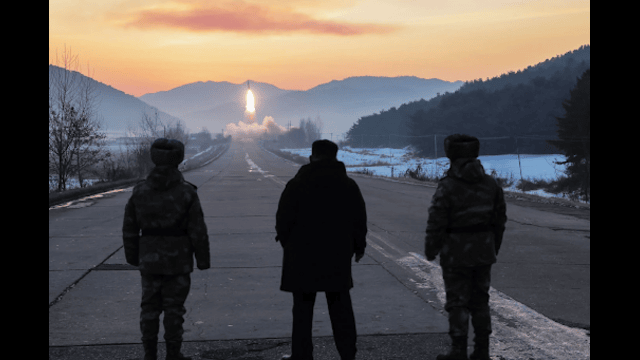
In this photo provided by the North Korean government, leader Kim Jong Un, center, inspects test-flights of hypersonic missiles, in Pyongyang, North Korea, Sunday, Jan. 4, 2026. Independent journalists were not given access to cover the event depicted in this image distributed by the North Korean government. The content of this image is as provided and cannot be independently verified.
North Korea on Monday claimed it successfully tested a hypersonic missile weapons system. Leader Kim Jong Un personally observed the launches. He stressed the urgency of strengthening the country’s nuclear war deterrence amid rising regional tensions.
The announcement came a day after South Korea and Japan detected multiple ballistic missile launches. Both neighbors accused Pyongyang of escalating military provocations. The tests also coincided with key diplomatic developments in the region.
Hypersonic Missile Drill Sends Strategic Message
According to the Korean Central News Agency, the drill involved a hypersonic missile system. The purpose was to verify combat readiness. It also aimed to sharpen the operational skills of missile units.
KCNA said the test evaluated the real-world performance of North Korea’s war deterrent. The state media described the exercise as a critical step in advancing national defense capabilities.
Kim expressed satisfaction with the outcome. He said the launch confirmed progress on an important defense technology. He also called for continuous upgrades to offensive weapons systems.
Why Hypersonic Weapons Matter
A functional hypersonic missile could significantly alter regional security dynamics. Such weapons can travel at extreme speeds. They can also maneuver mid-flight.
These features make hypersonic missiles harder to track and intercept. If proven effective, they could bypass U.S. and South Korean missile defense systems.
North Korea has tested similar weapons in recent years. However, foreign experts remain skeptical. Many question whether the missiles achieved true hypersonic speed and maneuverability.
Recent Weapons Tests Add to Concerns
The hypersonic missile test follows a series of recent weapons displays. In recent weeks, North Korea launched long-range strategic cruise missiles. It also tested newly developed anti-aircraft missiles.
State media has also released images of what appears to be a nuclear-powered submarine under construction. If confirmed, this would mark another major step in Pyongyang’s military ambitions.
Together, these developments suggest a coordinated effort to showcase military progress. Analysts say the timing is unlikely to be accidental.
Party Congress Looms Large
Observers believe North Korea is building momentum ahead of a major political event. The ruling Workers’ Party congress is expected soon. It will be the first such gathering in five years.
Historically, these congresses outline future policy directions. This includes military strategy and foreign relations. Many are watching for signals on North Korea’s stance toward the United States.
There is also speculation about whether Kim may revive stalled diplomatic talks. Nuclear negotiations with Washington have remained dormant for years.
Regional Diplomacy in Focus
North Korea’s nuclear program is also expected to feature in regional diplomacy. South Korean President Lee Jae Myung traveled to China on Monday. He is scheduled to meet President Xi Jinping.
Lee’s office said he would urge China to play a constructive role. Beijing remains North Korea’s closest ally and economic lifeline. Seoul hopes China can help ease tensions on the Korean Peninsula.
Global Events Shape Pyongyang’s Thinking
The missile tests followed a dramatic U.S. military operation elsewhere. Washington recently removed Venezuelan leader Nicolás Maduro from power. He was taken to the United States to face criminal charges.
North Korea sharply criticized the operation. It called it proof of what it described as U.S. aggression. Experts say such events reinforce Pyongyang’s distrust of Washington.
Kim Defends Nuclear Expansion
During the launch drill, Kim justified his nuclear ambitions. He cited growing geopolitical instability. He also pointed to complex international developments.
According to KCNA, Kim argued these realities demand stronger nuclear capabilities. He believes such weapons guarantee state sovereignty and regime survival.
As North Korea continues its weapons push, regional tensions remain high. The latest hypersonic missile claims will likely draw renewed scrutiny from global powers.