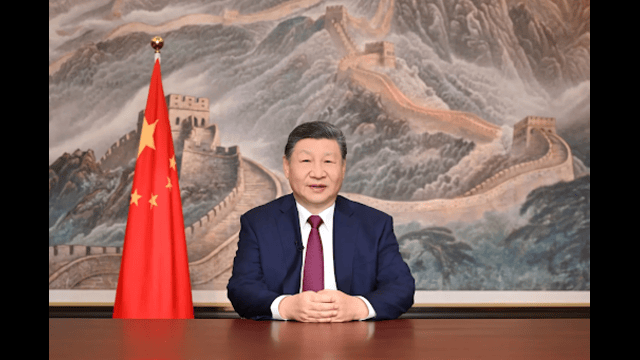
In this photo released by Xinhua News Agency, Chinese President Xi Jinping delivers his 2026 New Year Message in Beijing on Wednesday, Dec 31, 2025.
China has announced a fresh trade restriction targeting Japan.
The move comes as political and military tensions sharpen in East Asia.
Beijing says the decision is about national security.
Tokyo sees it as a direct and unfair pressure tactic.
The ban focuses on dual-use goods.
These are items that can serve civilian needs but also military purposes.
The timing has raised eyebrows across the region.
China Tightens Controls on Dual-Use Goods
China’s commerce ministry issued the ban on Tuesday.
It applies to exports of dual-use goods to Japan.
The restriction covers military users and certain civilian end-users.
Officials said these exports could enhance Japan’s military power.
According to the ministry, all such transfers are now prohibited.
The rule applies regardless of who makes the transaction.
Foreign individuals and organizations are also included.
Violators could face legal consequences under Chinese law.
The announcement did not list specific products.
However, technology items are widely believed to be affected.
Drones, navigation systems, and advanced electronics are key examples.
These tools can be adapted for surveillance or combat roles.
Japan Responds With Strong Protest
Japan reacted swiftly to the decision.
Senior diplomat Masaaki Kanai lodged a formal protest.
He met Chinese deputy consul Shi Yong to convey Tokyo’s stance.
Kanai described the ban as unacceptable.
He said it unfairly targets Japan alone.
According to Tokyo, the move deviates from international trade practices.
Japan has demanded that China withdraw the measure immediately.
The Japanese Foreign Ministry released a statement soon after.
It warned that such actions could further damage bilateral ties.
Relations between the two neighbors are already strained.
Taiwan Tensions Shape the Backdrop
The export ban comes amid rising tensions over Taiwan.
China claims the self-ruled island as its territory.
Japan has shown increasing concern over Taiwan’s security.
Late last year, Japan’s Prime Minister Sanae Takaichi made headlines.
She said Japan’s military could become involved if China attacked Taiwan.
Beijing reacted sharply to those remarks.
Since then, diplomatic exchanges have grown more hostile.
Security incidents have also increased.
Military Encounters Raise Alarm
In December, Japan reported a dangerous encounter.
Chinese military aircraft allegedly locked radar onto Japanese fighter jets.
Tokyo said the incident occurred despite a safe flying distance.
Such actions have fueled fears of miscalculation.
Japan believes China is testing its defenses.
China has not publicly accepted Tokyo’s version of events.
Japan Expands Its Military Capabilities
Japan is now accelerating its defense buildup.
The government plans to double annual defense spending.
Officials say the goal is to counter growing threats from China.
This marks a major shift for Japan.
The country has long followed a pacifist defense policy.
Rising regional risks are driving the change.
China Signals Through Military Drills
Last week, China conducted large military drills near Taiwan.
The exercises lasted two days.
Beijing said they were a warning to separatist forces.
Chinese Foreign Minister Wang Yi spoke during that period.
He criticized both Japan and Taiwan’s pro-independence voices.
Wang accused Japan of challenging China’s territorial sovereignty.
He also referenced the postwar international order.
China claims Japan’s current leadership is undermining it.
Historical Narratives Add to Strain
Chinese leader Xi Jinping echoed similar themes on Monday.
He met South Korean President Lee Jae Myung in Beijing.
Xi mentioned shared historical experiences against Japan.
He called on China and South Korea to work together.
His message focused on defending World War II outcomes.
Xi also spoke about maintaining peace in Northeast Asia.
A Trade Move With Strategic Meaning
China’s decision to ban exports to Japan goes beyond commerce.
It reflects deeper strategic and political tensions.
Dual-use goods have become a new pressure point.
As security rivalries intensify, economic tools are gaining prominence.
For Japan and China, the fallout could be long-lasting.
The region now watches closely for the next move.