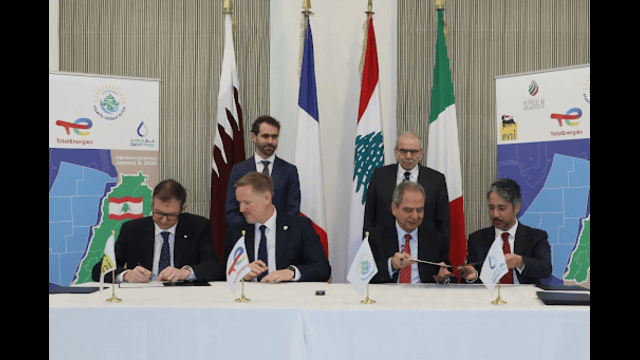
In this photo released by the Lebanese Government press office, Lebanese Prime Minister Nawaf Salam, right background, attends the signing of an international consortium deal for gas exploration in the cost of southern Lebanon between the Lebanese government and representing officials from the international consortium consisting of France’s Total, Italy’s ENI, and state-owned oil and gas company Qatar Energy, in Beirut, Lebanon, Friday, Jan. 9, 2026.
Lebanon has taken another step toward unlocking offshore energy resources despite its deepening economic crisis.
The government has signed a new gas exploration deal with an international consortium.
Officials hope future discoveries can revive the country’s shattered economy.
The agreement focuses on offshore Block 8, near Lebanon’s southern maritime border.
This area lies close to Israel, following a landmark maritime deal signed in 2022.
The Lebanon gas exploration deal reflects Beirut’s renewed push for energy investment.
Offshore Block 8 Takes Center Stage
The Lebanon gas exploration deal covers Block 8, located off the southern coast.
It follows years of delays caused by border disputes with Israel.
The 2022 maritime agreement cleared legal uncertainty over offshore exploration zones.
With borders clarified, Lebanon has accelerated licensing for offshore gas blocks.
Block 8 is among the most strategically significant zones under the new framework.
Officials believe it holds untapped exploration potential.
Deal Signed in Beirut
The agreement was signed at the government headquarters in downtown Beirut.
Energy Minister Joe Saddi represented Lebanon during the signing ceremony.
Senior officials from the international consortium also attended.
The consortium includes France’s TotalEnergies, Italy’s ENI, and Qatar Energy.
Qatar Energy is a state-owned oil and gas company.
Together, they form a powerful alliance for offshore exploration.
Seismic Surveys to Begin First
TotalEnergies confirmed that exploration will begin with seismic studies.
The consortium plans a 3D seismic survey covering 1,200 square kilometers.
This survey will assess gas prospects beneath the seabed.
The seismic phase is critical before any drilling decisions.
Data collected will determine whether Block 8 moves to drilling.
The Lebanon gas exploration deal depends heavily on these findings.
Economic Crisis Drives Energy Push
Lebanon is facing its worst economic collapse in modern history.
The national currency has lost much of its value.
Banks remain largely frozen, trapping citizen savings.
Gas discoveries could provide much-needed state revenue.
Officials see offshore energy as a long-term recovery tool.
The Lebanon gas exploration deal aligns with this broader economic vision.
Past Attempts Met With Setbacks
Lebanon approved its first offshore licenses in 2017.
TotalEnergies, ENI, and Russia’s Novatek were awarded two blocks.
One block was partly disputed with Israel at the time.
Exploration results were disappointing in northern waters.
Southern drilling faced repeated delays due to border tensions.
Progress stalled until the 2022 maritime agreement.
Drilling Restarted but Results Fell Short
In August 2023, an offshore drilling rig resumed work.
Operations took place in the Mediterranean Sea off Lebanon’s coast.
However, the drilling failed to yield commercial gas discoveries.
Despite setbacks, TotalEnergies reaffirmed its commitment.
CEO Patrick Pouyanné said exploration efforts would continue.
The company remains optimistic about other offshore areas.
Focus Shifts Fully to Block 8
Pouyanné said the consortium will now prioritize Block 8.
He stressed close cooperation with Lebanese authorities.
Partners ENI and Qatar Energy share this focus.
The Lebanon gas exploration deal signals persistence despite earlier failures.