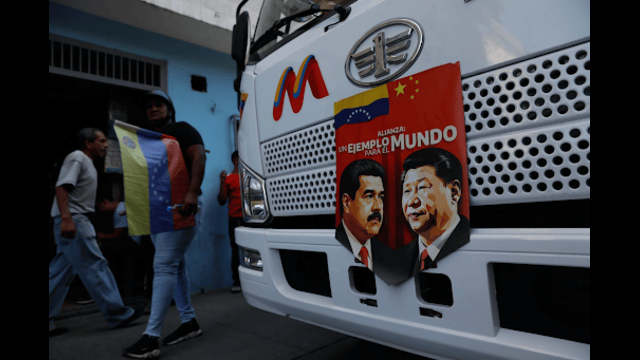
A banner on the front end of the bus.
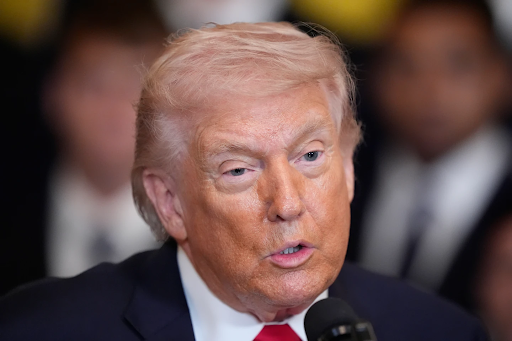
President Donald Trump is openly asserting U.S. control over Venezuelan oil.
But the reality is complicated.
A significant share of Venezuela’s oil is tied to China through long-standing contracts.
That overlap has created a sensitive geopolitical puzzle for Washington.
As Trump tightens control over Venezuela’s energy sector, Beijing’s financial and oil stakes loom large.
How the U.S. handles China’s claims could shape diplomacy, trade, and regional influence in coming weeks.
Trump Balances Pressure and Pragmatism
Despite tough rhetoric, experts expect Trump to avoid a direct clash with China over Venezuela.
The White House remains cautious amid fragile U.S.-China trade relations.
Trump is expected to visit Beijing in April.
The visit aims to preserve the trade truce reached with President Xi Jinping last year.
According to analysts, Washington wants leverage without escalation.
Venezuela, they argue, is unlikely to become a breaking point.
Craig Singleton of the Foundation for Defense of Democracies said the administration seeks controlled pressure.
He believes Trump will avoid turning Venezuela into a trade flashpoint with China.
China’s Debt and Oil Stakes in Venezuela
China is owed at least $10 billion by Venezuela, based on multiple estimates.
That debt was largely repaid through oil shipments under loan-for-oil agreements.
Two Chinese state-owned giants dominate Beijing’s oil interests.
China National Petroleum Corp and Sinopec hold rights to 4.4 billion barrels of reserves.
That figure makes China Venezuela’s largest foreign oil stakeholder.
It also places Beijing directly in Washington’s path.
The interim Venezuelan government, backed by the U.S., could challenge those agreements.
If deemed illegal, oil payments to China could stop entirely.
U.S. Oil Claims Add Another Layer
China is not alone in seeking compensation.
U.S. companies are owed tens of billions after Venezuela nationalized its oil industry.
It remains unclear whose claims will be honored first.
The order of repayment could spark disputes.
This week, the U.S. seized two sanctioned Venezuelan oil tankers.
The move signals Washington’s intent to control oil flows.
Energy Secretary Chris Wright said the U.S. will manage oil sales indefinitely.
Revenue will be held in U.S.-controlled accounts.
Officials claim the money will eventually benefit Venezuelans.
Critics remain skeptical.
Washington’s Strategy in the Western Hemisphere
The Trump administration plans to sell 30 to 50 million barrels initially.
The oil will come from Venezuelan storage facilities.
An administration official said the goal is clear.
The U.S. wants to reduce “adversarial outside influence” in the region.
This strategy mirrors past trade battles with China.
Beijing previously restricted rare-earth exports and soybean purchases.
Those tactics pushed Washington to respond aggressively.
Venezuela’s oil now serves as similar leverage.
How Deep Is China’s Exposure?
Between 2000 and 2023, Venezuela received $106 billion in Chinese loans.
AidData ranks it as Beijing’s fourth-largest credit recipient.
Exact repayment figures remain unclear.
Caracas stopped reporting debt details years ago.
Brad Parks of AidData said outstanding debt could exceed $10 billion.
U.S. sanctions may have delayed oil-based repayments.
The loans were structured around oil exports.
That model now faces disruption.
Libya Lessons Worry Beijing
Maduro’s capture triggered uncomfortable memories in China.
Analysts recalled Libya’s Moammar Gadhafi.
After Gadhafi fell in 2011, Chinese firms lost billions.
Many projects were abandoned overnight.
Chinese scholar Cui Shoujun warned of a similar risk in Venezuela.
A new government could invalidate Maduro-era deals.
China’s investments go beyond oil.
They include ports, railways, and telecom infrastructure.
All now face uncertainty.
Limited Impact, Long-Term Signal
Despite losses, analysts say China can absorb the shock.
Venezuelan oil forms only a small share of Chinese imports.
Beijing has diversified energy sources and expanded electrification.
Its exposure is strategic, not critical.
Still, Venezuela was China’s closest partner in Latin America.
It held a rare high-level strategic partnership.
Maduro’s removal weakens China’s foothold in the region.
That outcome aligns with Trump’s national security goals.
Beijing Pushes Back
China reacted sharply to Maduro’s capture.
Officials condemned U.S. force and demanded his release.
Beijing insisted economic ties with Venezuela remain lawful.
It rejected foreign interference claims.
Yet analysts doubt China’s ability to resist U.S. pressure.
Diplomatic protests may be Beijing’s only option.
As Trump, China, and Venezuela collide over oil, debt, and power,
the outcome could redefine influence in the Western Hemisphere.