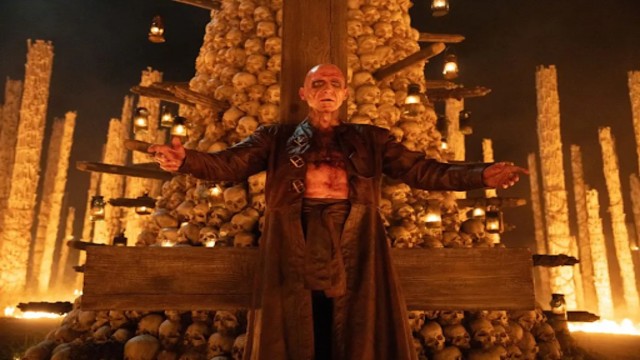
28 Years Later: The Bone Temple delivers a darker, bloodier sequel that leans fully into hardcore horror. Sony Pictures
The 28 Years Later universe has entered its darkest chapter yet. 28 Years Later: The Bone Temple, the latest installment in the long-running post-apocalyptic saga, expands the world first revived last year and pushes the franchise firmly into harsher, more unsettling territory.
Released as the second chapter in a planned trilogy, the film moves beyond survival horror into an exploration of moral decay, cult violence and humanity’s uneasy relationship with the infected. While the Rage virus remains a constant threat, the story increasingly suggests that civilization’s collapse has created dangers far more complex than zombies alone.
Directed by Nia DaCosta, the sequel marks a tonal shift from the restrained tension of the previous film, favoring visceral imagery and sustained psychological dread.
A New Director, A Sharper Edge
DaCosta takes over directing duties from Danny Boyle, who reintroduced the franchise with 28 Years Later and is expected to return for the final installment. While Boyle’s influence lingers, The Bone Temple adopts a more controlled, polished visual style that contrasts sharply with the gritty experimentation of earlier entries.
The film remains scripted by Alex Garland, preserving the franchise’s thematic continuity. Garland’s screenplay leans heavily into social allegory, depicting a world where ethical frameworks have eroded and violence has become ritualized.
Ralph Fiennes at the Center of the Story
At the heart of the film is Dr. Ian Kelson, played by Ralph Fiennes, a grieving physician who believes the infected may still be studied, treated—or even saved. His character oversees the Bone Temple itself, a towering structure made from human remains that serves as both a memorial and a warning.
Kelson’s approach to the Rage virus, particularly his attempts to understand the so-called “alphas,” reframes the infected not just as monsters but as remnants of a broken humanity. The performance anchors the film, presenting a man torn between scientific compassion and increasingly extreme choices.
Human Threats Eclipse the Infected
While the infected remain lethal, The Bone Temple introduces a new antagonist in the form of Jimmy Crystal, a cult leader portrayed by Jack O’Connell. Crystal commands a roaming group that blends religious fanaticism with sadistic violence, terrorizing survivors across the countryside.
The cult’s presence reinforces a long-standing theme within the franchise: when societal rules disappear, human cruelty often fills the void. Their actions are depicted as deliberate, ritualistic and often more disturbing than the chaos caused by the virus itself.
This narrative choice echoes earlier franchise moments in which organized groups, not zombies, posed the greatest threat—a concept now pushed to its extreme.
A Bloodier, More Unforgiving Film
Compared to earlier installments, The Bone Temple is notably more graphic. Scenes of ritual punishment, torture and mass violence mark a departure from the emotional restraint that defined 28 Years Later. The film makes little attempt to soften its imagery, instead using shock as a storytelling device.
Industry observers note that this escalation appears intentional, positioning the sequel as a bridge toward a climactic final chapter that may confront the consequences of unchecked brutality head-on.
Setting the Stage for the Finale
While The Bone Temple functions as a standalone narrative, it clearly sets up unresolved threads for a concluding film. Boyle has previously indicated his intention to return to direct the final installment, which is expected to bring thematic closure to the decades-spanning saga.
With its focus on grief, extremism and the collapse of moral order, 28 Years Later: The Bone Temple signals that the franchise is no longer just about survival—it’s about what remains when survival is no longer enough.
For audiences, the film represents both an escalation and a warning: the end of the world may not belong to monsters alone.