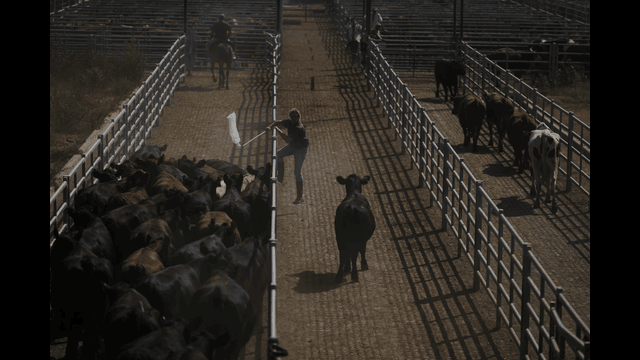
A worker moves cattle at the Agricultural and Livestock Market in Canuelas, Argentina, Tuesday, Jan. 13, 2026.
Talks began before the euro existed and China joined the WTO.
Now, after 25 years, the EU-Mercosur free trade agreement is finally becoming reality.
The European Union and South America’s Mercosur bloc are set to formally sign the landmark pact in Paraguay this Saturday.
The moment arrives amid rising protectionism and shifting global power balances.
A quarter-century deal reaches the finish line
The EU-Mercosur free trade agreement links Europe with Brazil, Argentina, Paraguay, and Uruguay.
Bolivia, Mercosur’s newest member, did not negotiate but may join later.
This is Mercosur’s first major trade agreement with a global economic power.
It creates one of the world’s largest free-trade zones.
The combined market covers more than 700 million people.
Together, the partners represent nearly one-quarter of global GDP.
The agreement will cut or eliminate tariffs on thousands of products.
Items range from Argentine beef and Brazilian minerals to European cars and wine.
A signal beyond tariffs and trade
The timing carries geopolitical weight.
The deal advances while the United States retreats from multilateral trade frameworks.
European Commission President Ursula von der Leyen called it a strong defense of multilateralism.
Brazilian President Luiz Inácio Lula da Silva praised dialogue and cooperation.
Experts say the agreement reshapes global alignments.
It reduces South America’s dependence on the United States and China.
It also offers the region greater strategic autonomy in global trade.
Analysts view the pact as a hedge against great-power competition.
South American agriculture eyes Europe
The EU-Mercosur free trade agreement heavily benefits South American agriculture.
The region gains wider access to Europe’s lucrative consumer market.
Preferential tariffs apply to beef, poultry, sugar, coffee, and juice.
In Argentina, exporters expect major savings.
A 20 percent tariff on high-quality beef quotas will vanish immediately.
Industry leaders estimate annual savings worth tens of millions of dollars.
The change marks a sharp turn for Argentina’s traditionally closed economy.
Carlos Colombo of the Cañuelas Cattle Market called it a paradigm shift.
He said Argentina is reopening itself to global trade.
President Javier Milei initially criticized Mercosur as ineffective.
He later embraced the bloc’s potential to cut tariffs and red tape.
Brazil joins the free-trade push
Brazil’s economy is also poised for gains.
Government estimates project $7 billion in new EU agricultural exports.
Instant coffee, poultry, and orange juice lead expected growth.
Officials see the agreement as a long-term export catalyst.
The EU-Mercosur free trade agreement also encourages investment flows.
European firms gain clearer access to South American markets.
Brazil hopes the pact strengthens its global trade standing.
European farmers force compromises
Resistance inside Europe has been fierce.
Farmers fear cheap imports will undercut domestic producers.
Environmental rules already strain EU agriculture.
Protests erupted across France, Poland, and other states.
To ease tensions, the EU added safeguards.
Strict quotas limit meat and sugar imports.
Environmental and animal welfare standards were strengthened.
Farm subsidies totaling $52 billion helped win reluctant support.
Despite concessions, France and Poland still opposed the deal.
Other agricultural powers backed it after securing protections.
EU leaders judged the agreement strategically essential.
“Cows for cars” and industrial gains
Critics nickname the pact “cows for cars.”
Europe’s auto industry stands to benefit significantly.
Tariffs of up to 35 percent on vehicles and parts will disappear.
German automakers regain ground lost to Chinese competitors.
Pharmaceutical, machinery, and construction sectors also gain.
Hundreds of millions of new consumers open to European exports.
Experts warn rejection would have pushed Mercosur closer to Beijing.
A historic step, with hurdles ahead
The EU-Mercosur free trade agreement still needs European Parliament ratification.
Final legal and political steps remain.
Years of near-misses temper optimism.
Yet supporters call this moment historic.
No agreement of this scale has linked the regions before.
If ratified, it could redefine trans-Atlantic trade for decades.