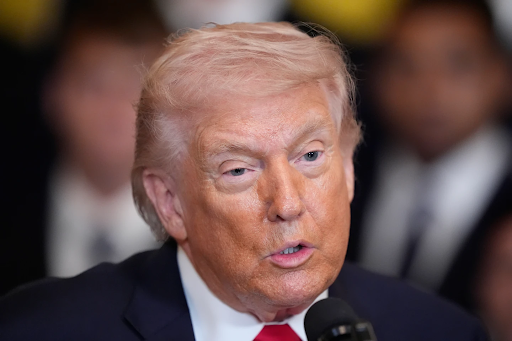
President Donald Trump speaks with reporters after arriving at Palm Beach International Airport, Monday, Jan. 19, 2026, in West Palm Beach, Fla.
President Donald Trump’s renewed Greenland push has triggered outrage across Europe.
His threat of sweeping tariffs has unsettled allies and rattled global markets.
The dispute is now testing NATO unity like never before.
Trump’s Greenland threats combine economic pressure with geopolitical ambition.
European leaders see them as reckless and deeply destabilizing.
The fallout is spreading fast, from Brussels to Davos.
Markets React to Trump Greenland Threats
Global investors reacted nervously as tensions rose.
Wall Street stocks slipped amid fears of a transatlantic trade war.
Uncertainty around NATO cooperation added to market anxiety.
Trump insists pressure brings results.
Critics argue it only fuels instability.
EU Pushes Back Hard on Greenland Dispute
European Commission President Ursula von der Leyen rejected Trump’s tariff plan.
She called it a clear mistake and a breach of trust.
She reminded Washington of last year’s U.S.–EU trade agreement.
“A deal is a deal,” she said firmly in Davos.
Von der Leyen warned against a downward spiral.
She said it would only benefit shared adversaries.
Macron Signals Economic Retaliation
French President Emmanuel Macron issued a sharp warning.
He said the EU could deploy its anti-coercion instrument.
The tool is known informally as the trade “bazooka.”
It allows sanctions against economic pressure tactics.
Macron called the Greenland standoff “crazy.”
He urged allies to focus instead on peace in Ukraine.
Denmark and Greenland Stand Firm
Denmark has rejected any discussion of transferring Greenland.
European nations have rallied behind Copenhagen.
Greenland’s Prime Minister Jens-Frederik Nielsen demanded respect.
He stressed international law and territorial integrity.
“International law is not a game,” he said.
He welcomed EU support but warned against coercion.
Trump Doubles Down on Greenland Stance
Trump offered few details when questioned by reporters.
“You’ll find out,” he said when asked how far he would go.
He predicted a deal that would satisfy NATO and Washington.
Yet he again criticized alliance members’ commitment to the U.S.
Trump claims Greenland is vital for Arctic security.
He cites possible threats from China and Russia.
NATO Alliance Faces Growing Strain
European leaders now speak more openly against Trump.
This marks a shift from earlier cautious diplomacy.
Danish Prime Minister Mette Frederiksen warned of tougher days ahead.
She said Denmark never sought confrontation.
Canadian Prime Minister Mark Carney went further.
He described the moment as a global rupture, not a transition.
Tariffs, Troops, and Escalation Risks
Trump plans 10% tariffs on eight European countries.
He links them to symbolic troop deployments in Greenland.
EU officials are considering countermeasures.
Options include tariffs or suspending trade agreements.
Belgian Prime Minister Bart De Wever urged Europe to stand tall.
He warned against becoming submissive to U.S. pressure.
Davos Becomes Diplomatic Battleground
Trump arrived in Davos as tensions peaked.
The forum could offer space for de-escalation.
Macron proposed a G7 meeting in Paris after Davos.
Trump publicly shared the message, confirming talks may happen.
Despite fiery rhetoric, Trump downplayed retaliation threats later.
He insisted any EU action would rebound against Europe.
Uncertain Path Ahead for Greenland Crisis
Legal challenges could also limit Trump’s tariff powers.
Asked about alternatives, Trump hinted at other options.
He refused to address questions about force.
The silence deepened European concerns.
Trump’s Greenland threats have reshaped alliances overnight.
The coming weeks may define NATO’s future direction.