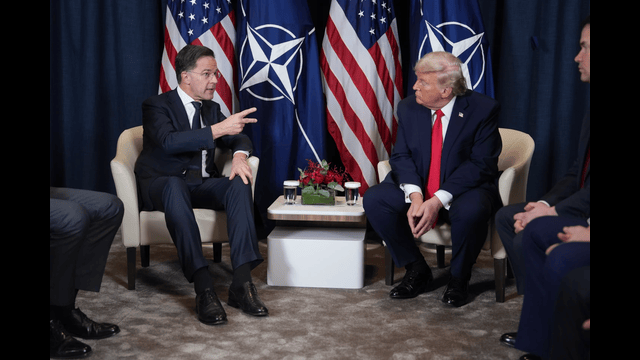
President Donald Trump, right, meets with NATO Secretary General Mark Rutte during a meeting on the sidelines of the Annual Meeting of the World Economic Forum in Davos, Switzerland, Wednesday, Jan. 21, 2026.
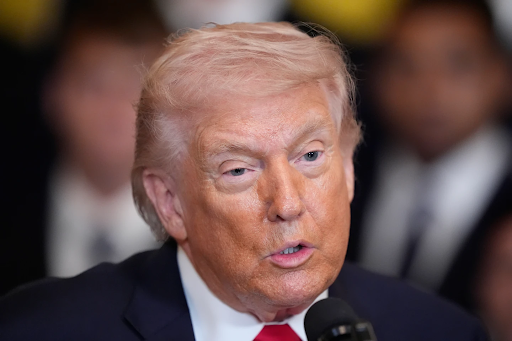
President Donald Trump abruptly withdrew his threat to impose tariffs on European allies over Greenland.
The reversal came after NATO leaders agreed on a future Arctic security framework.
Only hours earlier, Trump had insisted the United States wanted full control of Greenland.
The sudden shift eased fears of a deepening transatlantic crisis.
In a post on his social media platform, Trump said he reached an understanding with NATO’s chief.
He described it as a “framework of a future deal” focused on Arctic security.
The announcement quickly cooled tensions that had rattled allies and markets alike.
NATO Talks Change the Tone
Trump revealed that additional talks on Greenland were already underway.
These discussions include possible links to the Golden Dome missile defense program.
The proposed system is valued at $175 billion and would place U.S. weapons in space.
Details remain scarce.
However, European officials say one idea involves expanding U.S. military bases in Greenland.
Denmark and NATO could cooperate to support a larger American presence there.
It remains unclear whether this proposal is part of the agreed framework.
Tariff Threats Suddenly Dropped
The president had threatened tariffs on Denmark and seven other European nations.
The tariffs were meant to pressure allies into talks over Greenland’s future.
Rates were set to begin at 10 percent next month.
They would rise to 25 percent by June.
Trump’s decision to cancel the tariffs followed NATO’s reassurance.
Alliance chief Mark Rutte publicly confirmed NATO would defend the U.S. if attacked.
Shortly after, Trump announced the tariff rollback.
A Familiar Pattern From Trump
This was not Trump’s first tariff retreat.
In April, he threatened sweeping global import taxes.
Markets reacted sharply, prompting a rapid policy reversal.
This time, the stakes were higher.
Trump had used the World Economic Forum in Davos to press his Greenland demands.
He suggested NATO owed the U.S. for decades of protection.
His remarks unsettled allies and raised questions about alliance unity.
Denmark Welcomes the Pause
Denmark responded cautiously but positively.
Foreign Minister Lars Løkke Rasmussen welcomed the tariff suspension.
He also praised Trump for ruling out force over Greenland.
Rasmussen urged dialogue on Arctic security.
He stressed Denmark’s sovereignty remains non-negotiable.
Copenhagen remains open to addressing U.S. concerns, within clear limits.
National Security at the Center
Trump argues Greenland is vital for U.S. national security.
He points to rising Russian and Chinese activity in the Arctic.
The U.S. already operates a major military base on the island.
Still, Trump insists more control is necessary.
He has framed the issue as a matter of global safety.
Allies, however, reject any suggestion Greenland is for sale.
Greenland Prepares Its People
While leaders debated, Greenland’s government urged preparedness.
Authorities released a crisis handbook in Greenlandic and English.
Residents were advised to store food, water, and fuel for five days.
In Nuuk, citizens took the warning seriously.
Many stocked up on essentials, including candles and dry food.
Some dismissed Trump’s words as political pressure.
Others felt preparation was wise.
Anger and Unease on the Ground
Some Greenlanders felt insulted by Trump’s rhetoric.
They objected to the island being described as a strategic object.
Local residents stressed Greenland is home to real communities.
One resident said living in the Arctic requires constant readiness.
Another warned that political threats add new uncertainty.
Despite the tariff rollback, unease lingers.
Markets and Allies Breathe Easier
Financial markets rebounded after Trump’s announcement.
U.S. officials also expressed quiet relief.
Many feared lasting damage to NATO relations.
For now, the Trump Greenland tariffs crisis has eased.
Yet questions remain about future negotiations.
The Arctic, it seems, will stay at the center of global strategy.