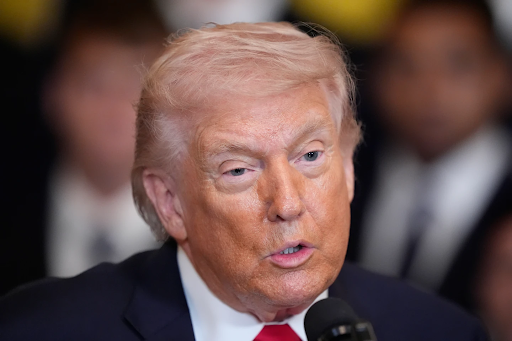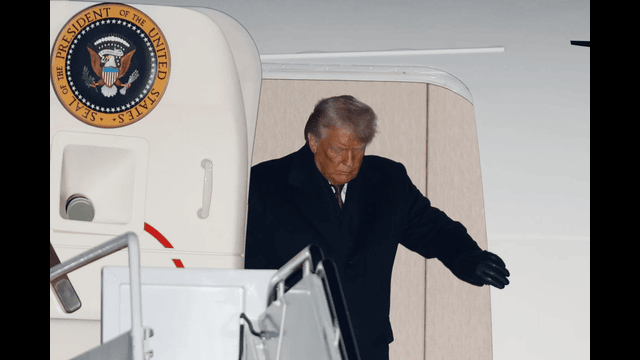
President Donald Trump arrives on Air Force Oneat Joint Base Andrews, Md., Thursday, Jan. 22, 2026, after returning from the World Economic Forum in Davos.
U.S. President Donald Trump dominated headlines during his brief but high-impact Davos visit this week.
His appearance reshaped conversations at the World Economic Forum, eclipsing traditional themes and debates.
The annual gathering usually highlights global growth, climate action, and business cooperation.
This year, Trump Davos rhetoric shifted attention sharply toward geopolitics and political spectacle.
Observers said the forum unfolded on two separate tracks.
One focused on technology and artificial intelligence.
The other revolved around Trump’s political messaging and policy signals.
Jane Harman, former U.S. congresswoman, summed it up succinctly.
She said Davos felt divided between AI discussions and Trump-led geopolitics.
Trump Davos Speech Grabs Attention
Trump stayed in Davos for roughly 24 hours.
He delivered a lengthy, freewheeling speech highlighting America’s global leadership.
The address mixed policy claims with bold, sometimes exaggerated assertions.
Unlike earlier Davos visits, the reception was not universally warm.
California Governor Gavin Newsom openly criticized Trump during media interactions.
Yet several international leaders offered praise instead of pushback.
NATO Secretary-General Mark Rutte welcomed Trump’s defense commitments.
Ukrainian President Volodymyr Zelenskyy praised his role in seeking an end to war.
Both leaders cited Trump’s efforts to strengthen Western security guarantees.
Growing Western Divisions Surface
A recurring theme during Trump Davos discussions was Western fragmentation.
Leaders warned that political rifts among allies were deepening.
Canadian Prime Minister Mark Carney described the situation as a lasting rupture.
He suggested trust within Western alliances may never fully recover.
These concerns surfaced repeatedly in panels and closed-door meetings.
They underscored unease about future cooperation under shifting U.S. policies.
Greenland Tariff Threat Sparks Backtrack
Days before Davos, Trump reignited tensions with European allies.
He announced tariffs targeting eight European countries.
The move followed their opposition to his Greenland acquisition proposal.
Trump initially insisted on acquiring Greenland outright.
The statement triggered backlash across Europe and the United States.
By midweek, Trump reversed course dramatically.
He announced a new framework agreement on Arctic security instead.
In a social media post, Trump cited discussions with NATO’s Rutte.
The shift eased tensions with Denmark and broader European partners.
‘Board of Peace’ Proposal Divides Leaders
At Davos, Trump unveiled plans for a new “Board of Peace.”
The body aims to support ceasefire efforts in Israel’s war with Hamas.
It would also shape Gaza’s long-term political future.
Several countries expressed support, including Indonesia and Argentina.
Belarus, Kosovo, and others signaled interest as well.
European allies remained skeptical of the proposal.
They rejected Trump’s claim that it could rival the United Nations.
Amnesty International chief Agnes Callamard criticized the idea sharply.
She said the plan lacked clarity and historical grounding.
Callamard urged reforming existing U.N. structures instead.
AI Optimism Competes With Politics
Despite Trump Davos dominance, artificial intelligence remained influential.
Tech leaders promoted optimism around AI-driven productivity and growth.
Elon Musk and Nvidia CEO Jensen Huang made notable appearances.
Musk discussed robotics and AI energy demands.
He also criticized tariffs on Chinese solar panels.
Huang dismissed fears of massive job losses from AI expansion.
He argued AI would create infrastructure and skilled trade employment.
Anthropic CEO Dario Amodei raised alarms over U.S.-China tech rivalry.
He likened advanced chip exports to dangerous strategic concessions.
Forum Ends on Optimistic Note
Despite political tensions, business leaders embraced cautious optimism.
The forum’s message emphasized dialogue over fear-driven predictions.
BlackRock CEO Larry Fink closed the event with a hopeful quote.
He echoed Musk’s belief in optimistic thinking over pessimism.
As Trump Davos moments faded, uncertainty lingered.
Yet the forum reaffirmed its core belief in cooperation and progress.