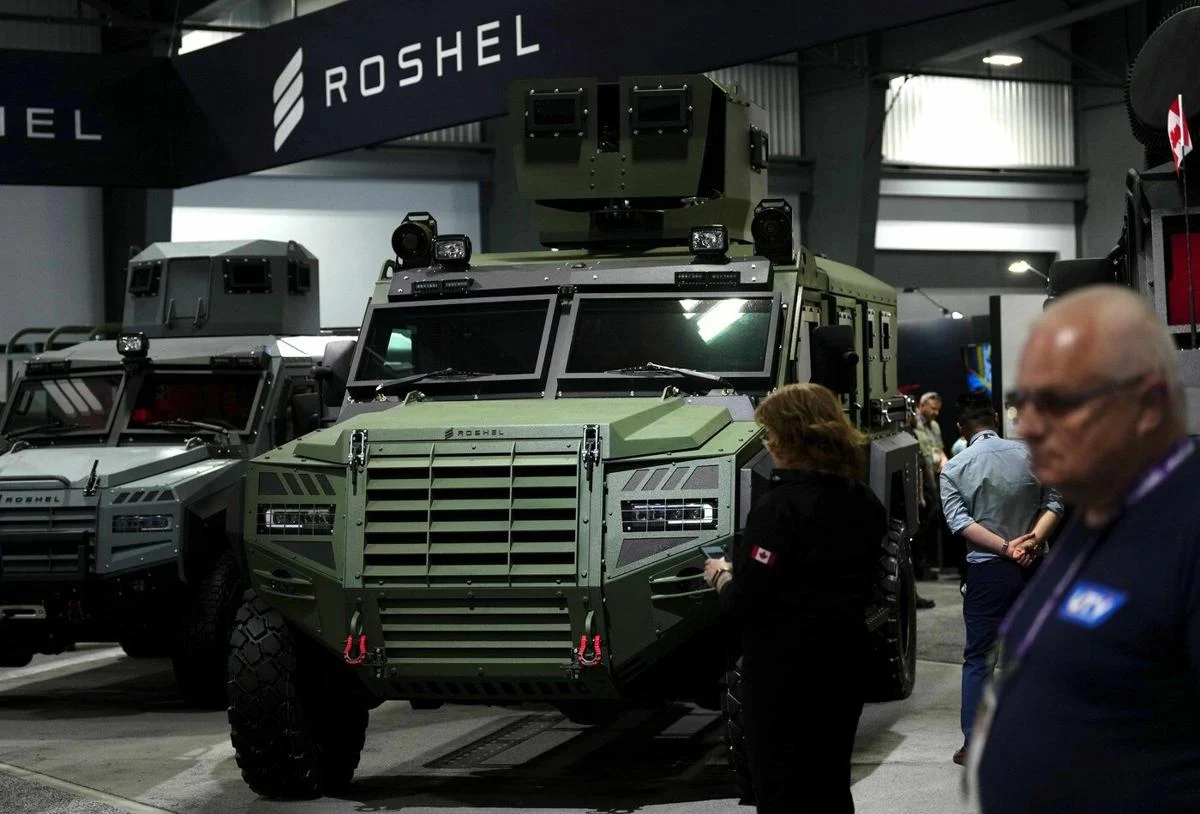
Roshel armored vehicles were on display at the Canadian Association of Defence and Security Industries trade show in Ottawa on Wednesday, May 28, 2025. THE CANADIAN PRESS
Several Canadian companies now face sharp criticism over their business ties to U.S. Immigration and Customs Enforcement, as President Donald Trump pushes ahead with a large-scale deportation campaign in the United States. Community groups, activists, and some politicians say these business links raise serious concerns, especially following recent reports of civilians killed during enforcement actions in Minnesota.
Companies named in the public debate include Canadian defense manufacturer Roshel and Vancouver-based firms Hootsuite and the Jim Pattison Group.
Property deal draws local concern
The property arm of the Jim Pattison Group owns a warehouse in Virginia that the U.S. Department of Homeland Security plans to purchase. The department said it intends to use the building as an ICE processing facility and outlined plans to renovate the site with added security and equipment.
Local officials in Hanover County, Virginia, said they did not begin the project and received formal notice last week. The county confirmed its council would meet to discuss next steps and review zoning rules related to federal use of the property.
Some residents worry the facility could increase immigration enforcement in the area and bring tougher action against protesters. Emily Lowan, leader of the Green Party of British Columbia, urged people online to boycott businesses connected to Jimmy Pattison.
Social media firm faces protests
Hootsuite, another Vancouver-based company, also came under fire after records showed it provides social media services to the U.S. Department of Homeland Security. The contract allows the use of the Hootsuite platform and support services and carries a value of up to $2.8 million.
A protest is planned outside the company’s Vancouver office, with organizers calling on Hootsuite to cancel its contracts and issue a public apology.
Hootsuite chief executive Irina Novoselsky acknowledged public concern and condemned recent events. “What we are watching unfold right now is wrong,” she said, calling the loss of life and fear in communities “devastating.”
She said the company’s work does not involve tracking or monitoring individuals. “Our use case with ICE does not include tracking or surveillance of individuals using our tools. Any claim otherwise is false and prohibited under our terms of service,” she said.
Novoselsky added that the company works with governments around the world to help them understand public discussion without supporting specific policies.
Armored vehicle order sparks outrage
Canadian defense company Roshel also faced criticism after ICE set aside millions of dollars to purchase 20 armored vehicles from the firm. Advocates raised concerns about the agency’s past conduct and questioned whether Canadian companies should supply equipment to it.
Roshel operates manufacturing plants in Ontario and opened a facility in Michigan in 2024. The company has said most of its orders come from U.S. defense and law enforcement agencies.
Activists shared images they claim show Roshel vehicles at the scene of a fatal shooting involving federal agents in Minneapolis. Officials have not confirmed the footage.
Political and expert reactions
Public Safety Minister Gary Anandasangaree said Canadian law does not block companies from doing business with U.S. agencies. He said company leaders should explain their own decisions.
British Columbia’s attorney general, Niki Sharma, urged businesses to reflect on their role. “We watch in horror at what's happening there,” she said, adding that leaders should avoid actions that contribute to harm.
Marketing expert Stephen McGill said companies cannot stay silent when controversy arises. “Leaders need to engage, not retreat,” he said. “Ending a relationship isn’t a failure. It’s accountability.”