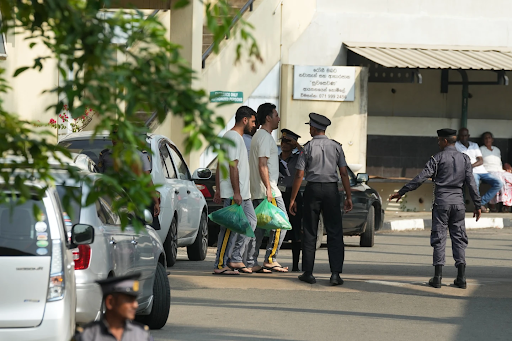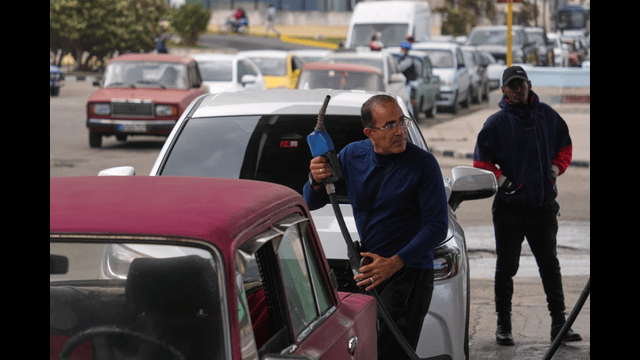
A driver refuels others wait in a long line behind to fill up at a gas station in Havana, Cuba, Tuesday, Jan. 27, 2026.
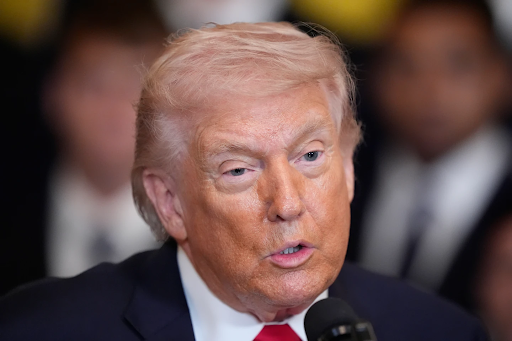
President Donald Trump has escalated pressure on Cuba with a new executive order.
The move threatens tariffs on any country supplying oil to the island.
Cuba is already struggling with a severe energy shortage.
The decision could deepen its economic and humanitarian crisis.
A New Tariff Threat Takes Shape
On Thursday, Trump signed an order targeting Cuba’s oil lifelines.
The directive allows tariffs on goods from countries selling oil to Cuba.
It aims to restrict fuel supplies reaching the Caribbean nation.
Officials say the step fits Trump’s hardline Cuba policy.
The policy instantly drew attention to Mexico.
Mexico has been one of Cuba’s key oil suppliers.
It has also voiced political solidarity with Havana for years.
Mexico in the Crosshairs
Mexico’s role places it under intense U.S. scrutiny.
The country has acted as a crucial energy partner for Cuba.
This has continued despite efforts to strengthen U.S.-Mexico ties.
Mexican President Claudia Sheinbaum has balanced diplomacy carefully.
She has sought cooperation with Trump on several issues.
At the same time, she has avoided breaking ties with Cuba.
Trump Defends His Position
Asked if the order aimed to “choke off” Cuba, Trump pushed back.
He described Cuba as a “failing nation.”
Trump said survival looked increasingly unlikely for the island.
He denied using the term “choke,” but defended the pressure.
The White House has not detailed how quickly tariffs would apply.
Officials also avoided naming specific countries publicly.
Cuba Condemns the Order
Havana responded with sharp criticism.
Foreign Minister Bruno Rodríguez called the move “brutal aggression.”
He warned of extreme hardship for Cuban citizens.
Rodríguez accused Washington of coercion and blackmail.
He said the U.S. was forcing others to join its embargo.
Cuban officials insist the policy violates international norms.
Cuban Officials Push Back
Deputy Foreign Minister Carlos F. de Cossio echoed those claims.
He said decades of U.S. economic pressure have failed.
The new order, he argued, only tightens the blockade.
He warned other nations face tariff threats for trading freely.
Countries must now choose between commerce and U.S. penalties.
Mexico Signals Caution, Not Retreat
Trump and Sheinbaum spoke by phone Thursday morning.
Sheinbaum later said Cuba was not discussed.
She stressed Mexico’s commitment to humanitarian aid.
Mexico’s foreign affairs secretary raised the issue with U.S. officials.
He highlighted Mexico’s desire to act as a mediator.
Humanitarian support to Cuba, he said, remained important.
Oil Shipments Under Scrutiny
Speculation has grown over Mexico’s oil exports to Cuba.
Cuba relies heavily on foreign fuel amid its crisis.
U.S. sanctions have worsened shortages for years.
Pemex data shows nearly 20,000 barrels daily reached Cuba in early 2025.
By late September, shipments reportedly dropped sharply.
Experts tracking satellites estimated flows near 7,000 barrels.
Mixed Signals From Mexico City
Sheinbaum has offered limited clarity publicly.
She avoided direct answers during press briefings.
On Tuesday, she acknowledged a temporary pause in shipments.
She described the pause as routine supply fluctuation.
She denied acting under U.S. pressure.
She called oil decisions a matter of sovereignty.
The following day, she clarified her remarks.
She said shipments were not fully suspended.
Humanitarian aid, she added, would continue.
Uncertainty Looms Over Cuba
Trump’s order adds new uncertainty for Havana.
Fuel shortages already plague daily life.
Drivers have waited hours for gasoline this week.
The long-term impact of Trump tariffs Cuba oil policy remains unclear.
What is certain is rising anxiety across the island.
For now, Cuba faces yet another test of endurance.